Panels
Surface paneling nodes - subdivide surfaces into repeating tessellation patterns for facades, cladding, and structural skins.
5 nodes in this group
Nodes
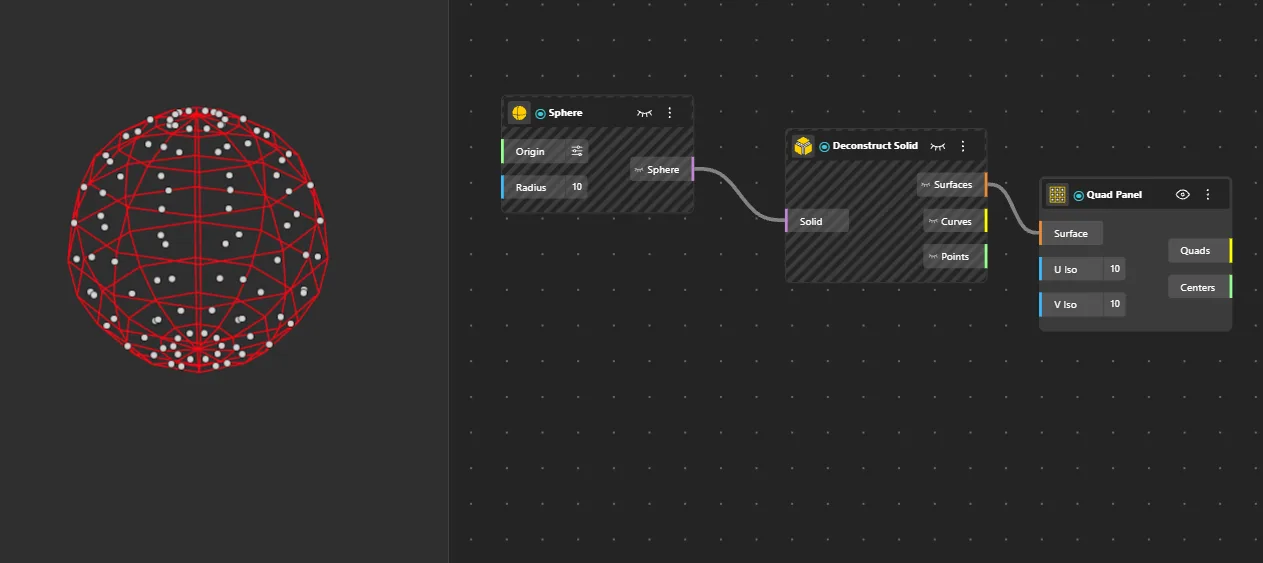
Quad Panel
Behavior
Generates a paneling pattern made of four-sided quadrilateral panels across a surface. Each panel is a planar quad defined by the UV subdivision grid. Panel shapes follow surface curvature - on curved surfaces, quads become non-planar. For flat fabrication, combine with Planar check or use Triangle panels instead. U-Iso and V-Iso control division density.
Inputs
Surface, U-Iso, V-Iso
Outputs
Panels
Pairs With
Loft Surface, Extrude Curve, Side Thickness
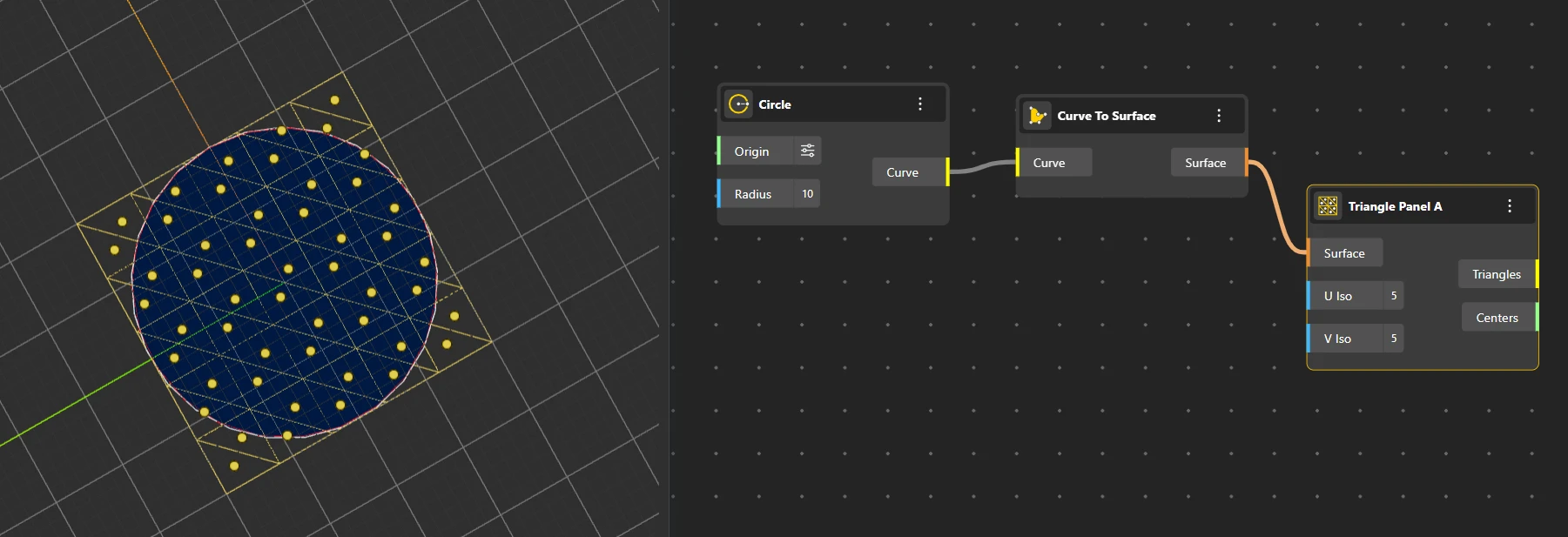
Triangle Panel A
Behavior
Creates triangular panel subdivisions across a surface using one orientation method. Each quad cell in the UV grid is split diagonally into two triangles. Triangular panels are always planar regardless of surface curvature, making them ideal for flat-sheet fabrication (laser cutting, CNC). The "A" variant splits quads along one diagonal direction consistently.
Inputs
Surface, U-Iso, V-Iso
Outputs
Panels
Pairs With
Revolve Surface, Side Thickness
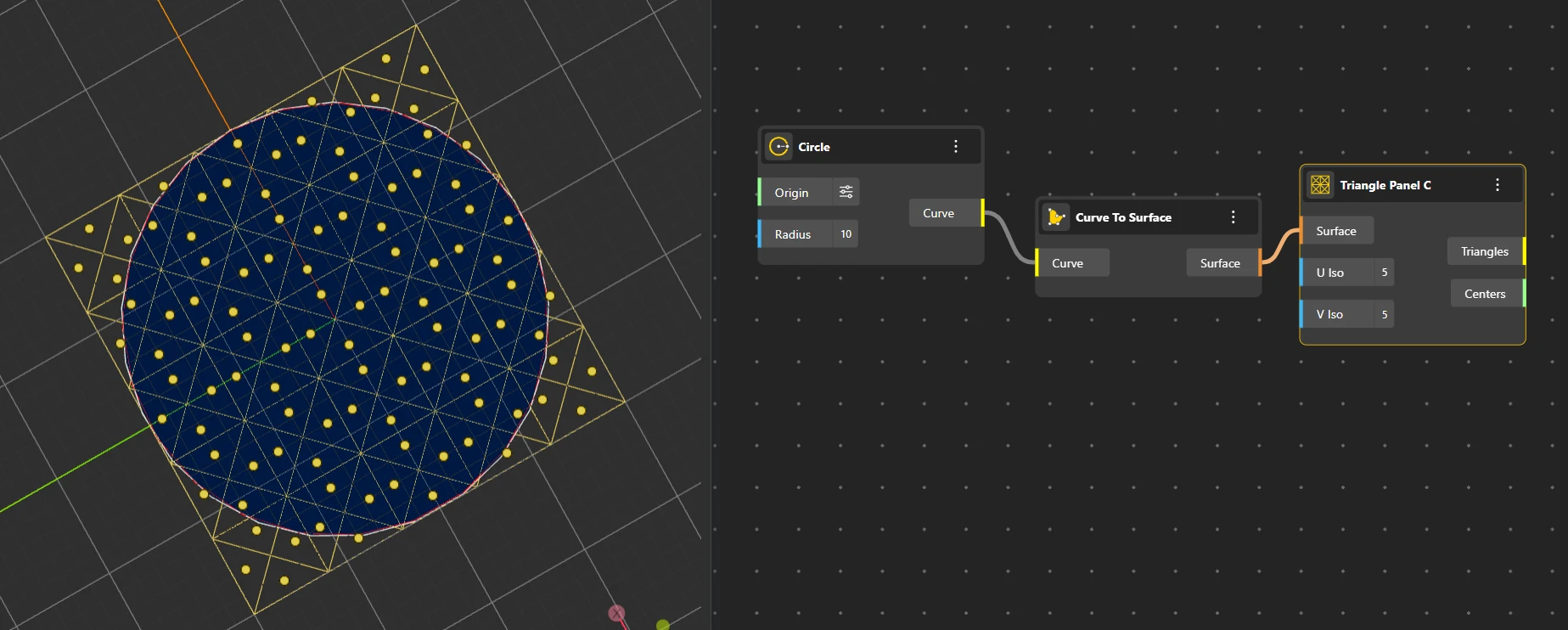
Triangle Panel C
Behavior
Produces a triangular panel pattern with an alternative subdivision method. The diagonal split direction varies, creating a different visual rhythm than Triangle Panel A. The "C" variant alternates the diagonal split direction across rows or columns, producing a herringbone-like triangle pattern rather than a uniform diagonal. Still guarantees planar panels on curved surfaces.
Inputs
Surface, U-Iso, V-Iso
Outputs
Panels
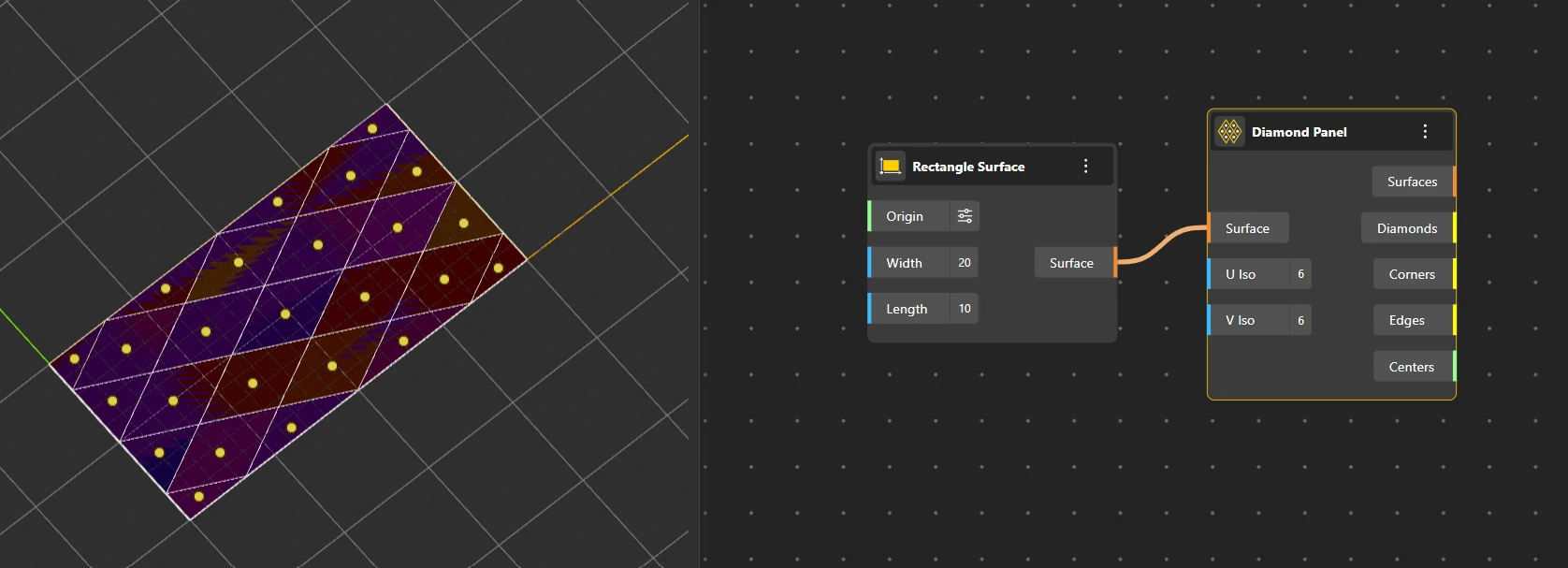
Diamond Panel
Behavior
Creates a pattern of four-sided diamond-shaped panels across a surface. Diamonds are formed by connecting midpoints of adjacent UV grid cells, producing a 45-degree rotated pattern. Diamond panels are rotated relative to the UV grid, so the panel edges run diagonally across the surface rather than aligned with the surface edges. Commonly used for architectural shading systems and decorative screens.
Inputs
Surface, U-Iso, V-Iso
Outputs
Panels
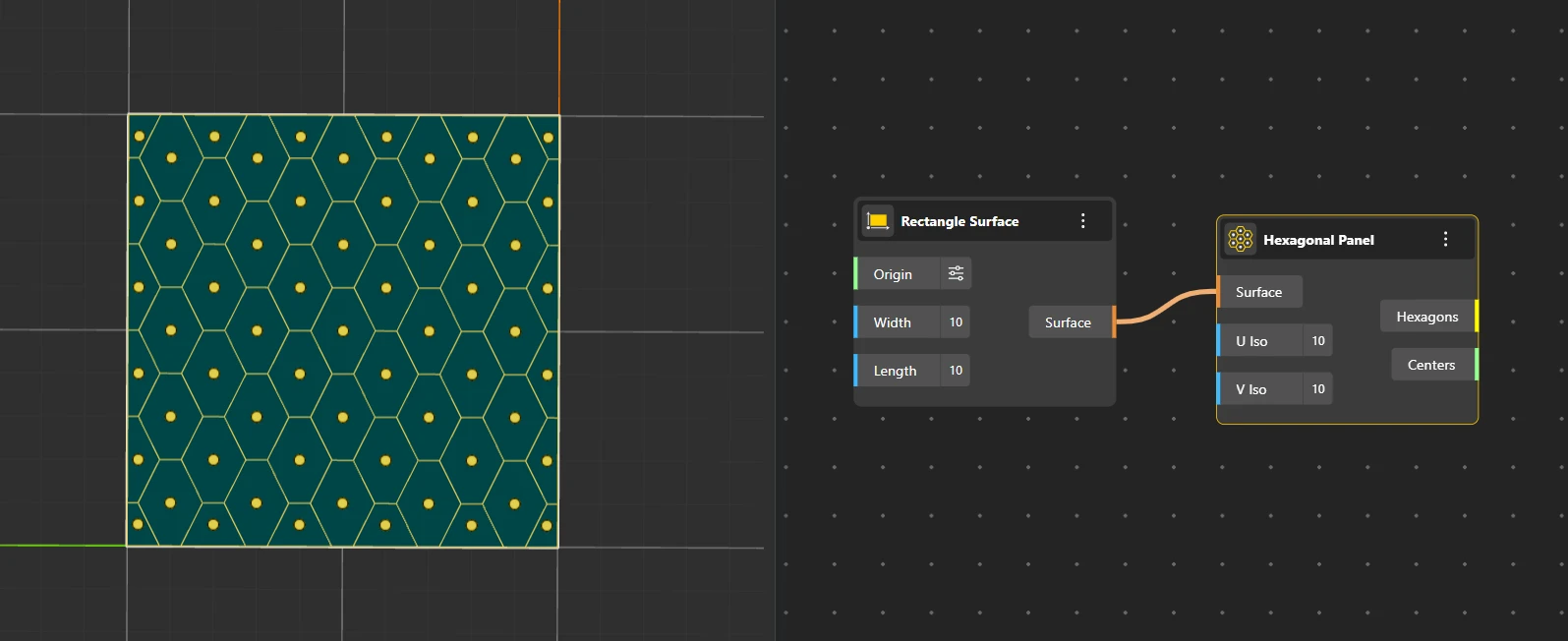
Hexagonal Panel
Behavior
Generates a six-sided hexagonal panel pattern across a surface, forming a honeycomb-like structure. Each cell is a regular hexagon defined by the UV subdivision density. Hexagonal tessellations provide the highest area-to-perimeter ratio of any regular polygon tiling, making them structurally efficient. On curved surfaces, hexagons deform to follow curvature. Panel count is approximate - edge hexagons may be trimmed.
Inputs
Surface, U-Iso, V-Iso
Outputs
Panels
Pairs With
Loft Surface, Side Thickness, Apply Material