Toolset
Curve and geometry modification tools - offset, fillet, chamfer, divide, explode, join, project, rebuild, and material application.
27 nodes in this group
Curve Modification
Generate reference planes at positions along curves, divide and modify curve geometry, and apply materials.
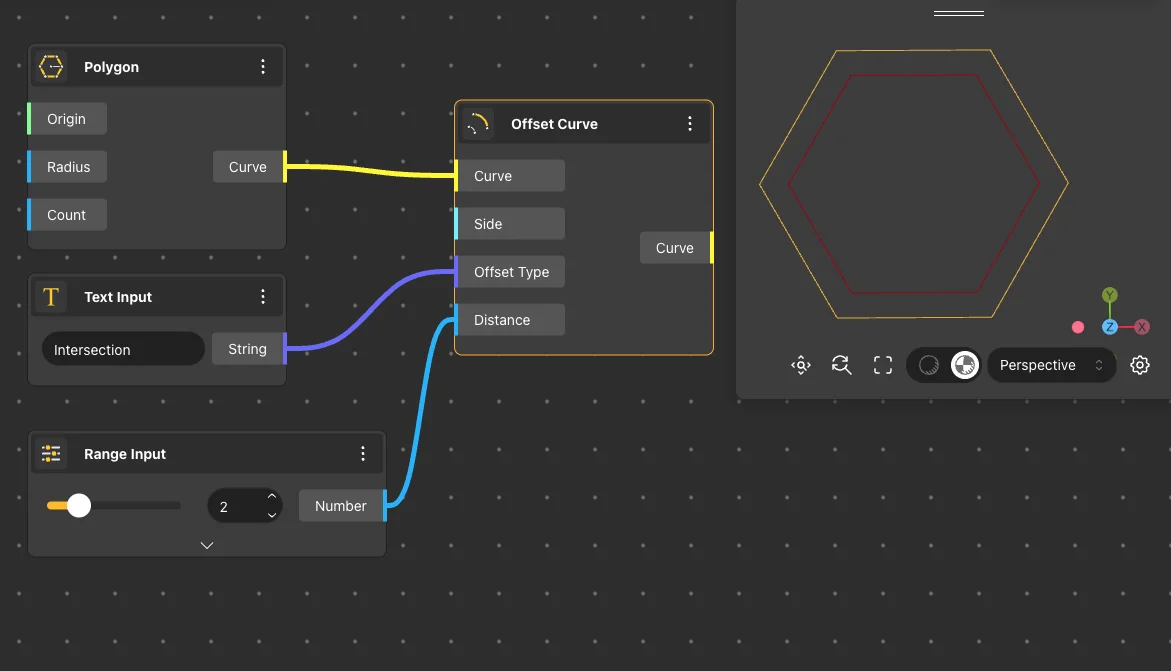
Offset Curve
Behavior
Creates a parallel curve at a specified distance from the original, on one or both sides. Offset Type controls how gaps between segments are handled. Default: Distance 2, Offset Type "Arc". Three offset types: Arc (smooth rounded transitions between segments), Intersection (sharp clean corners by extending segments until they meet), Tangent (smooth tangent-preserving corners). Connect a Boolean to toggle one-side vs. both-sides offset.
Inputs
Curve, Distance, Both Sides, Type
Outputs
Offset
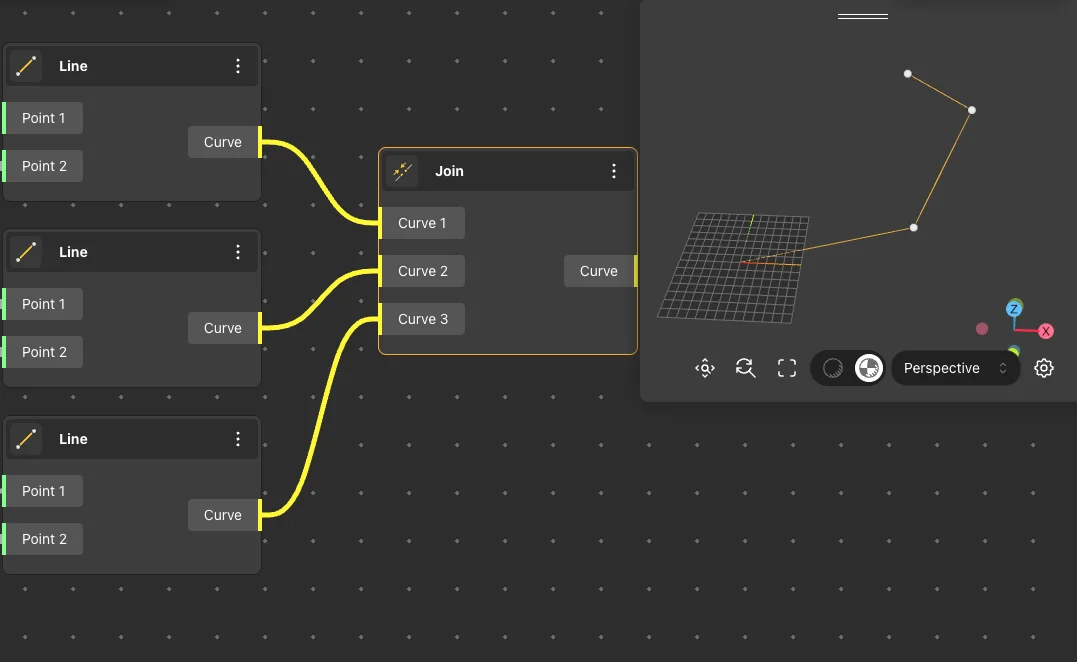
Join
Behavior
Combines multiple curve pieces into one continuous curve. The output behaves as a single curve for downstream operations. Additional curves added via "add port".
Inputs
Curves
Outputs
Joined
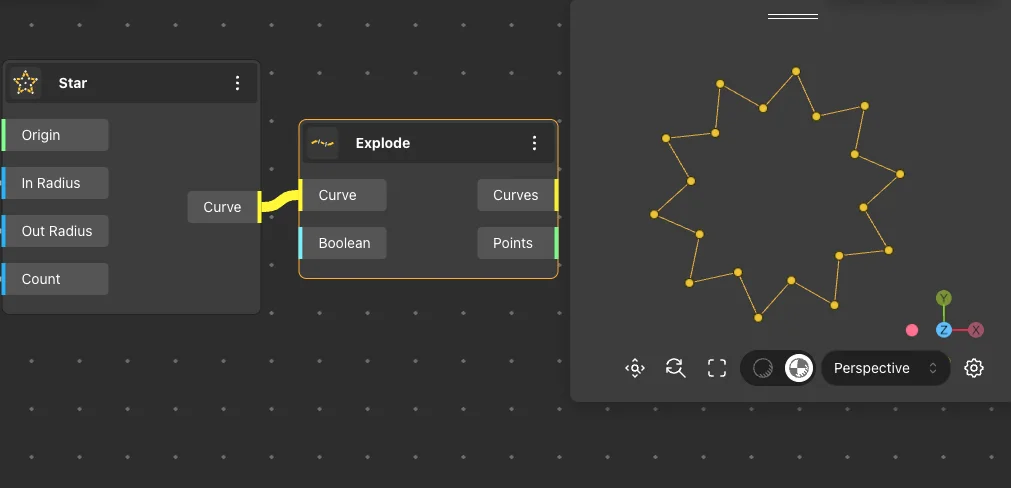
Explode
Behavior
Breaks a curve into its individual segments and returns both the segment curves and their junction points.
Inputs
Curve
Outputs
Segments, Points
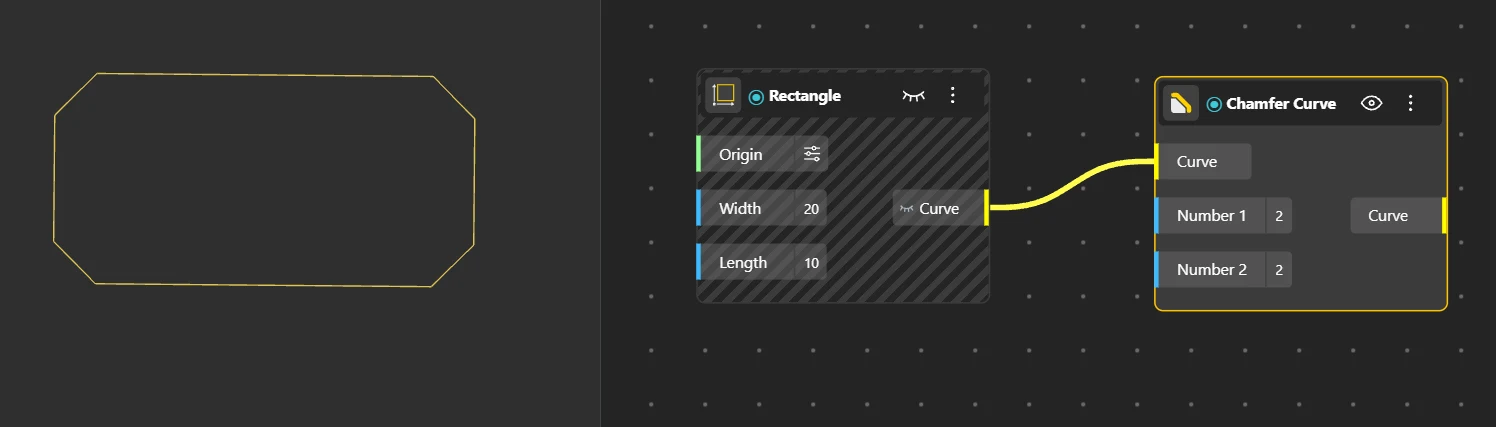
Chamfer Curve
Behavior
Cuts curve corners and replaces them with straight angled edges - a flat bevel at each corner.
Inputs
Curve, Distance
Outputs
Chamfered
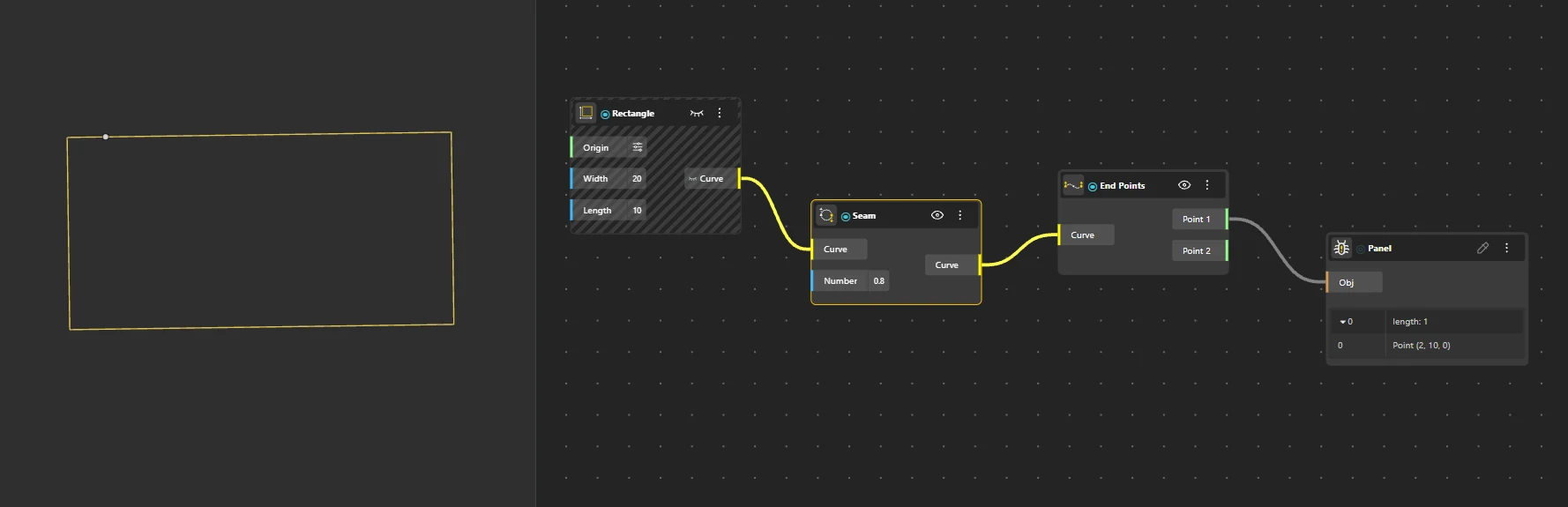
Seam
Behavior
Changes the starting point of a closed curve to adjust mapping or orientation. The curve shape is unchanged but its parametric start/end shifts.
Inputs
Curve, Parameter
Outputs
Reseamed
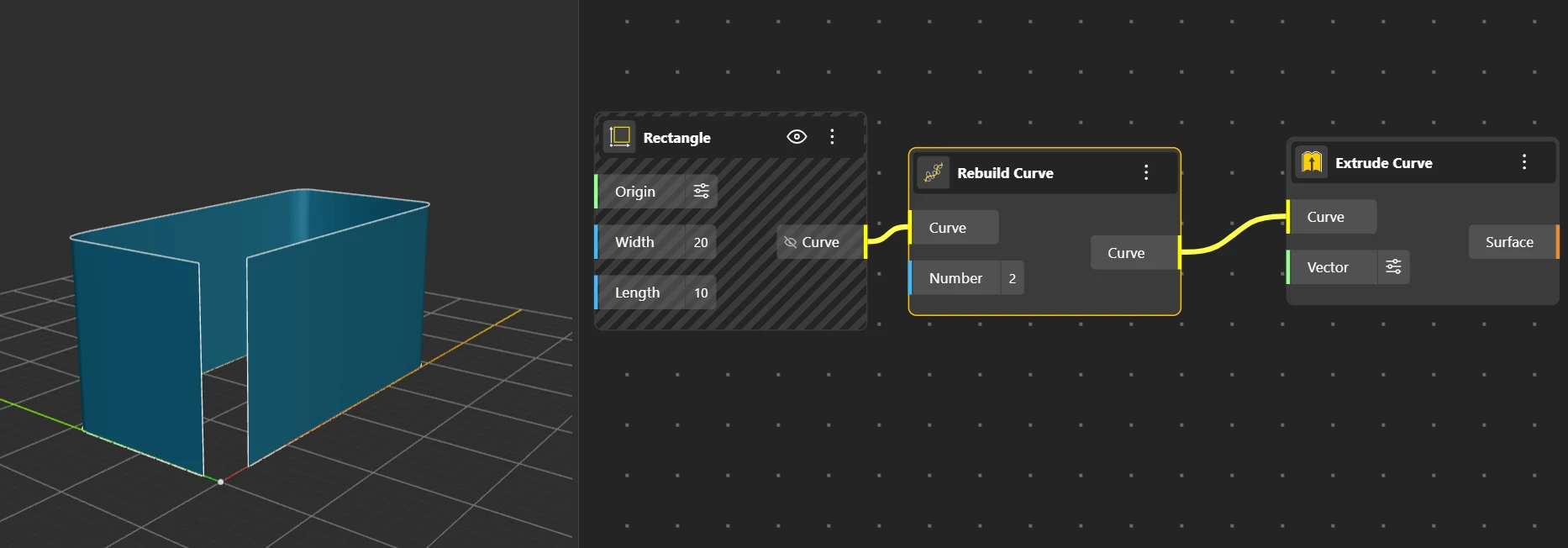
Rebuild Curve
Behavior
Reconstructs a curve using a new set of evenly-spaced control points. The degree parameter controls the smoothness - higher degree = smoother curve with fewer sharp transitions. Default: Degree 3. Rebuilding simplifies complex curves into cleaner NURBS definitions. Degree 1 = polyline (straight segments), Degree 2 = parabolic, Degree 3 = standard smooth NURBS. Higher degrees are smoother but harder to control locally.
Inputs
Curve, Degree
Outputs
Rebuilt
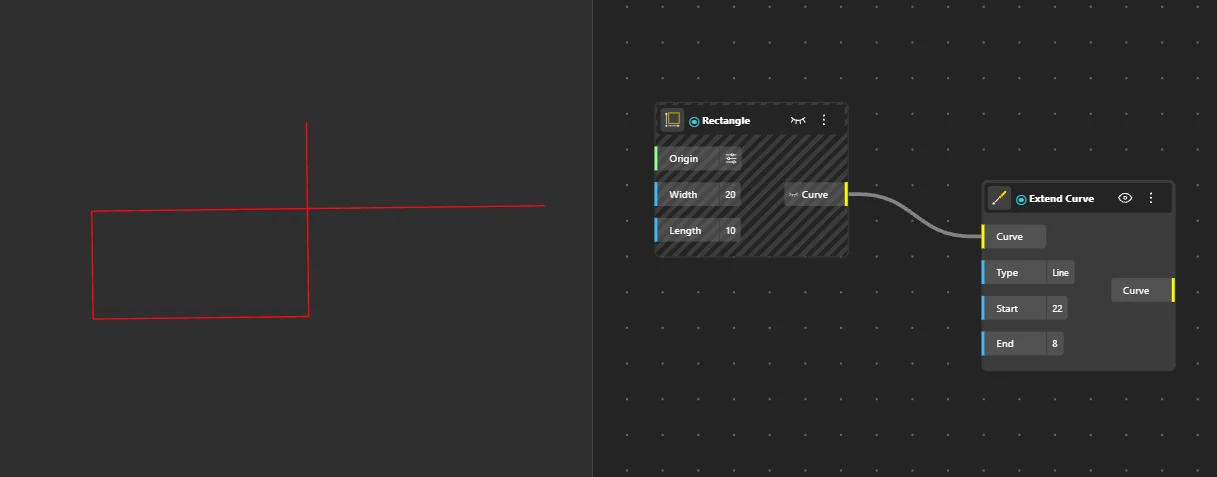
Extend Curve
Behavior
Lengthens a curve past its original endpoints by a specified distance or to a target geometry.
Inputs
Curve, Distance
Outputs
Extended
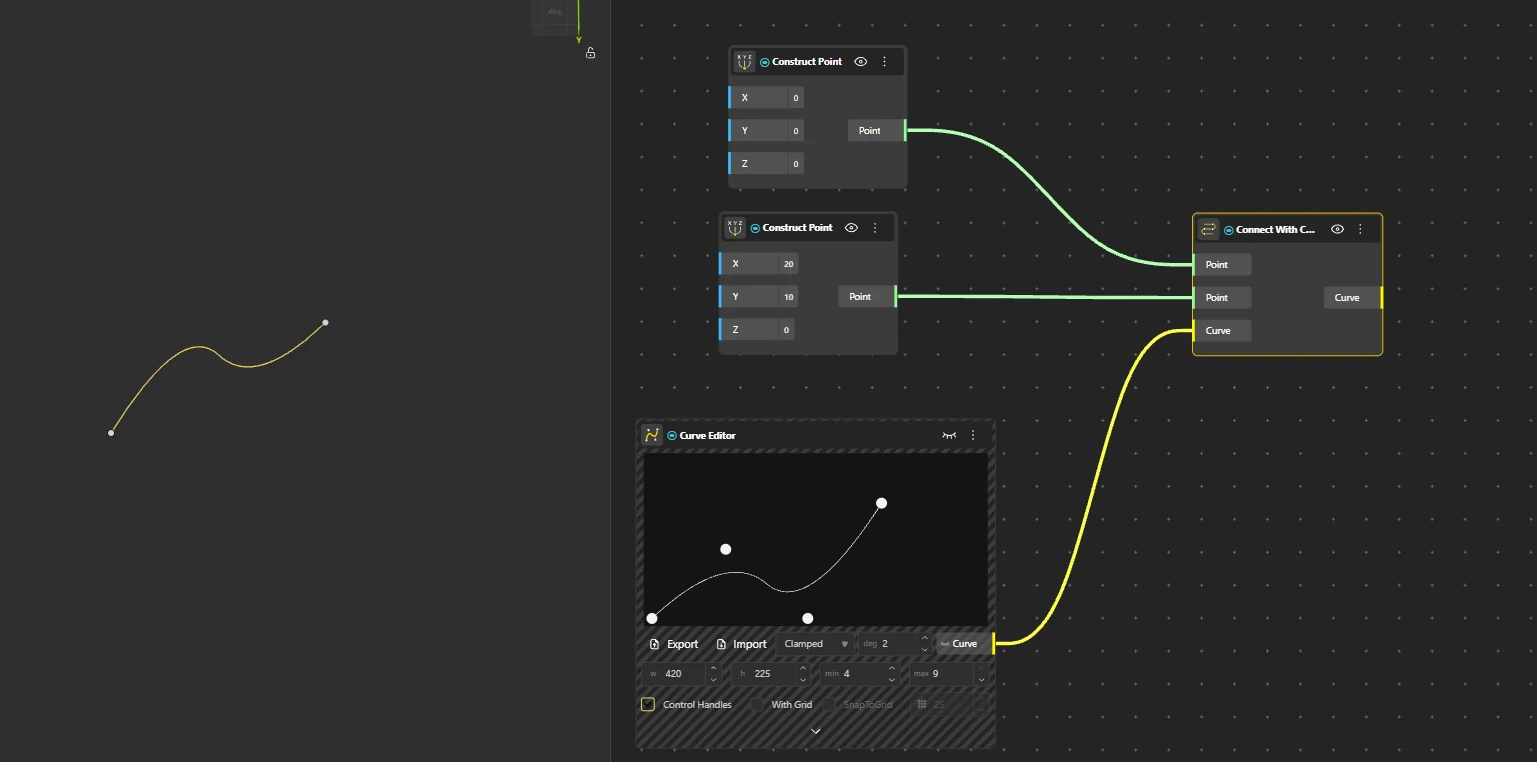
Connect With Curve
Behavior
Generates a smooth connecting curve between two points or shapes, creating a transition bridge.
Inputs
Start, End, Profile
Outputs
Curve
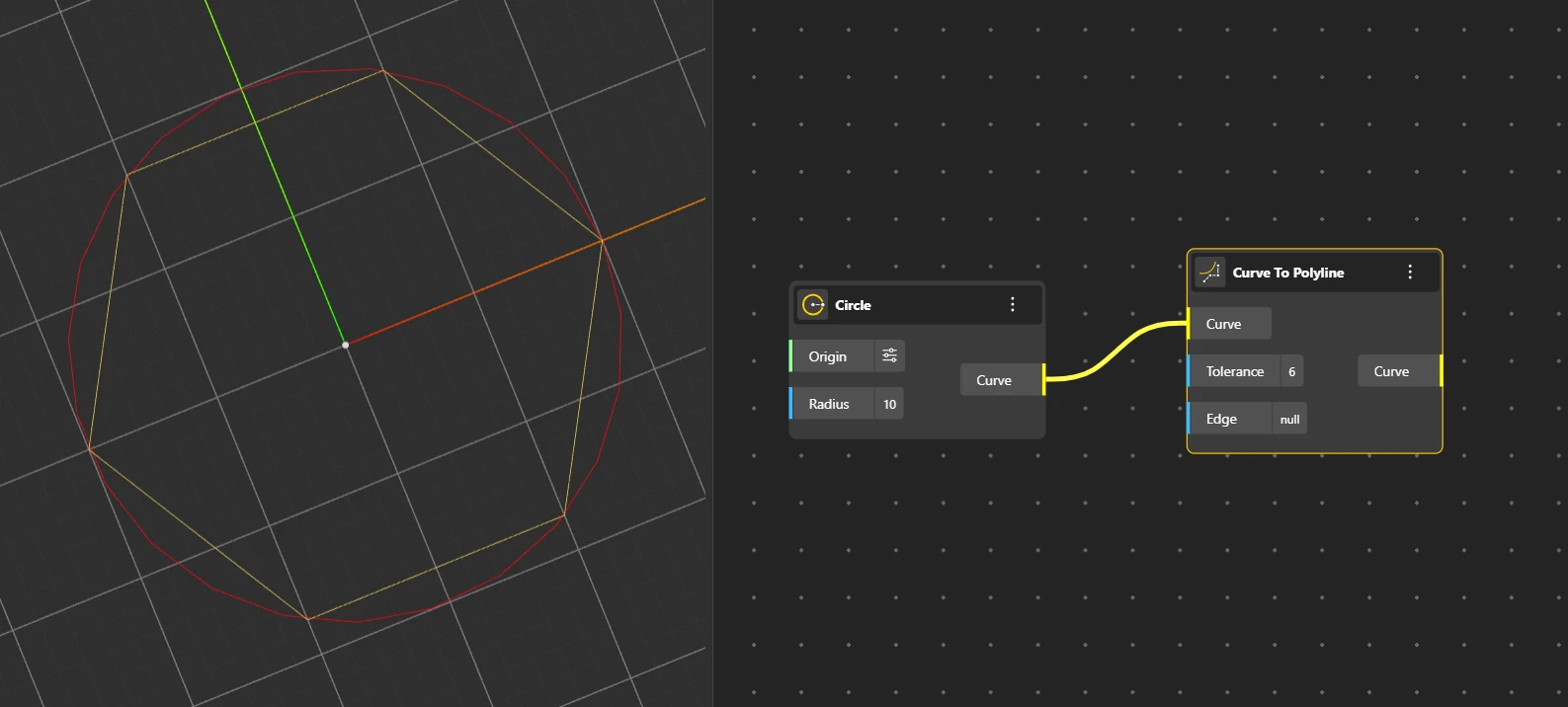
Curve To Polyline
Behavior
Converts a smooth curve into a series of straight line segments (polyline approximation). Tolerance controls the maximum deviation from the original curve.
Inputs
Curve, Tolerance
Outputs
Polyline
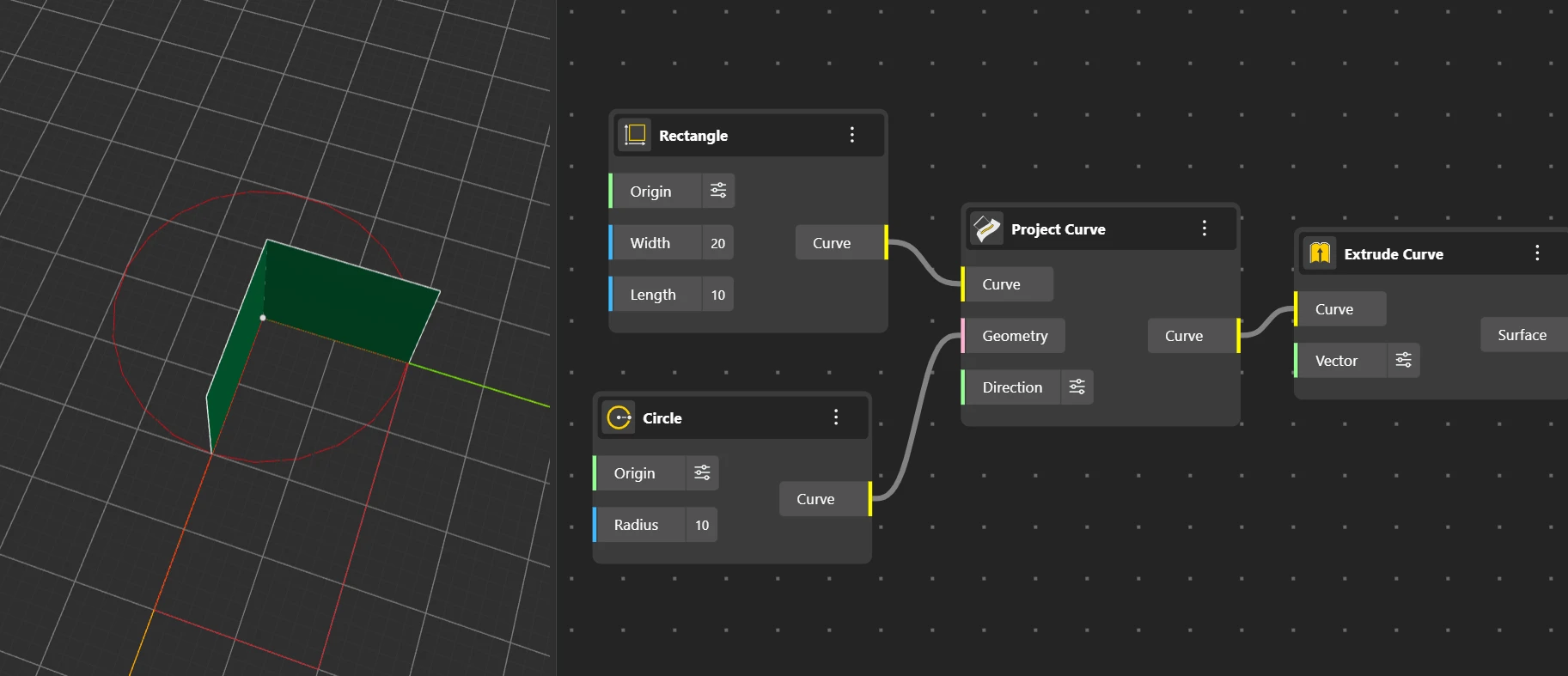
Project Curve
Behavior
Projects a curve onto a geometry (surface or solid) along a chosen direction vector.
Inputs
Curve, Target, Direction
Outputs
Projected
Cull Curves
Behavior
Removes curves from a list based on filters or conditions. Used to clean up curve collections before downstream operations.
Inputs
Curves, Pattern
Outputs
Filtered
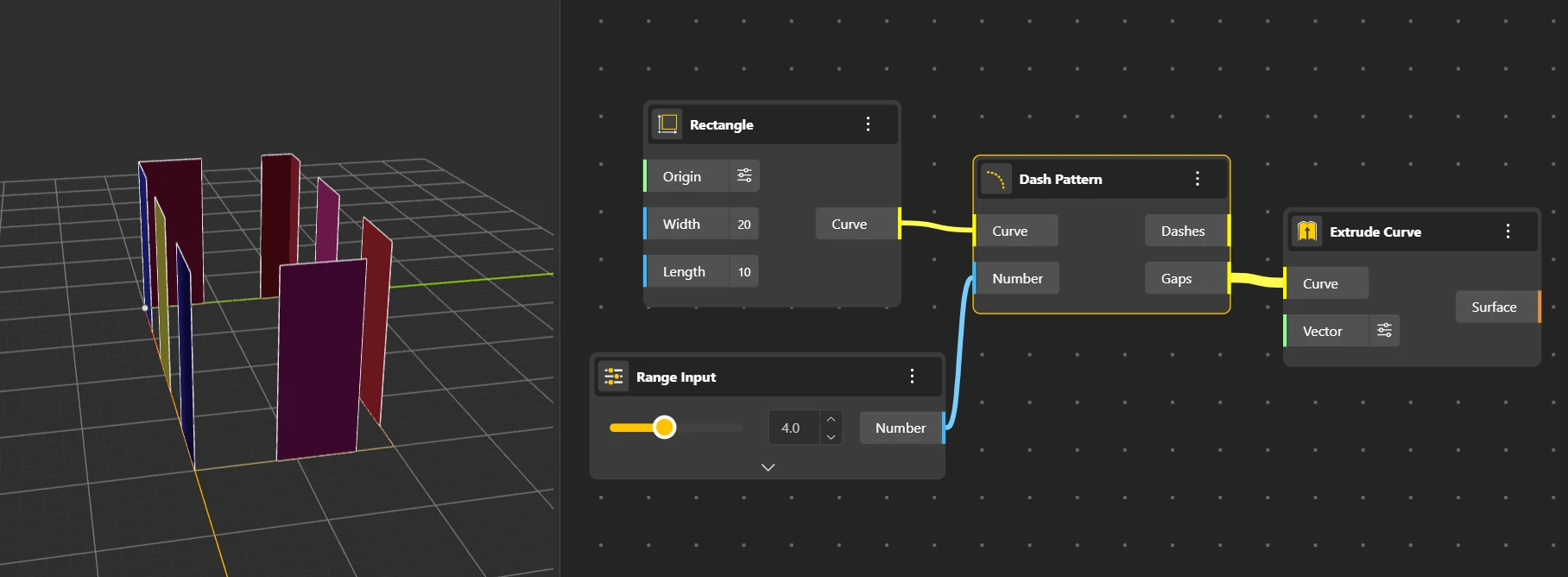
Dash Pattern
Behavior
Applies a dashed pattern to a curve, splitting it into alternating dash and gap segments based on the specified pattern length.
Inputs
Curve, Length
Outputs
Dashes, Gaps
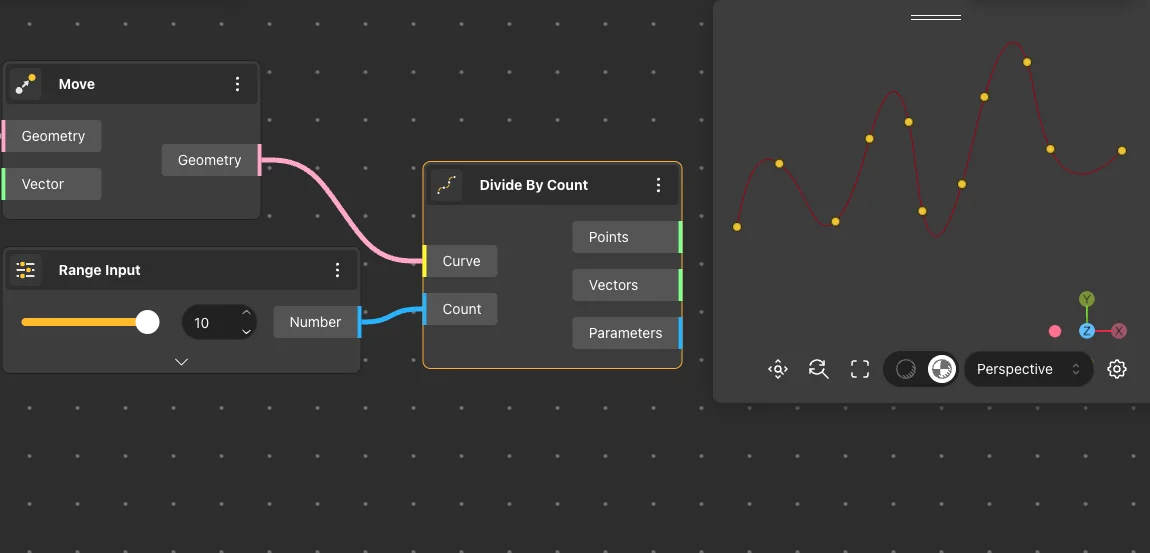
Divide By Count
Behavior
Segments a curve into equal-length portions and returns the division points, tangent vectors at each point, and parameter values. Default: Count 4 (produces 5 points including start and end). The Tangent vectors output shows the curve direction at each division point - useful for orienting objects placed at those positions.
Inputs
Curve, Count
Outputs
Points, Tangents, Parameters
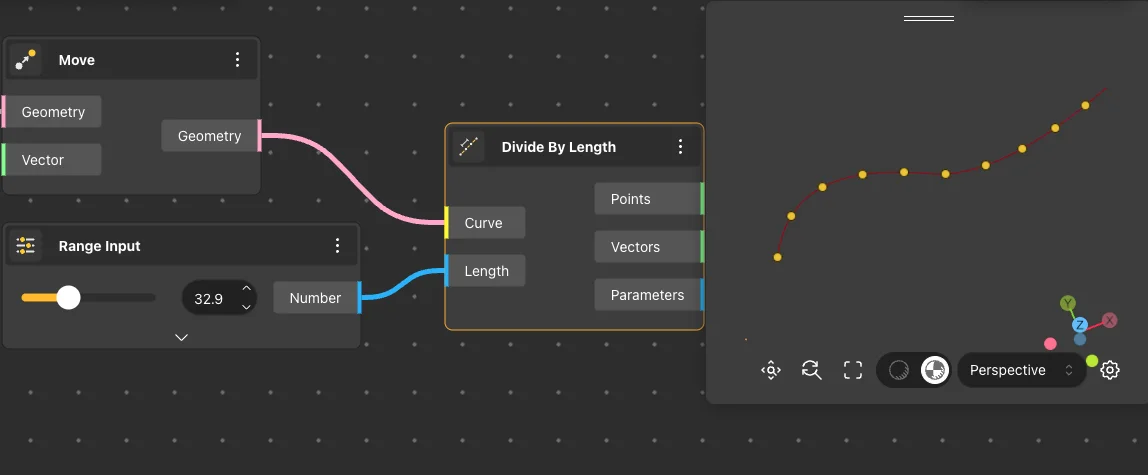
Divide By Length
Behavior
Splits a curve into equal-length segments. Returns division points, tangent vectors, and parameters.
Inputs
Curve, Length
Outputs
Points, Tangents, Parameters
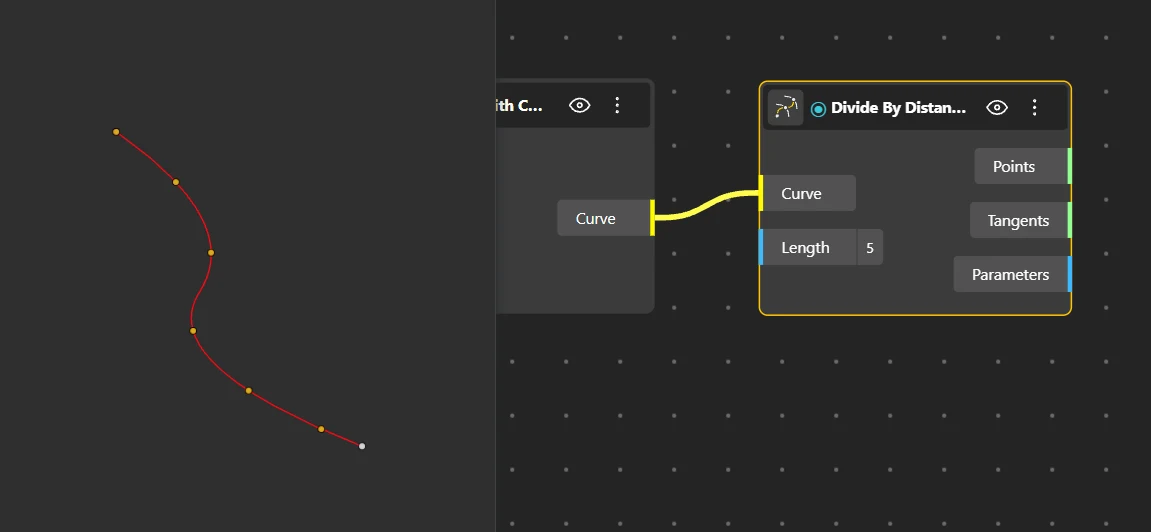
Divide By Distance
Behavior
Places points along a curve at a fixed spacing distance between each point.
Inputs
Curve, Distance
Outputs
Points, Tangents, Parameters
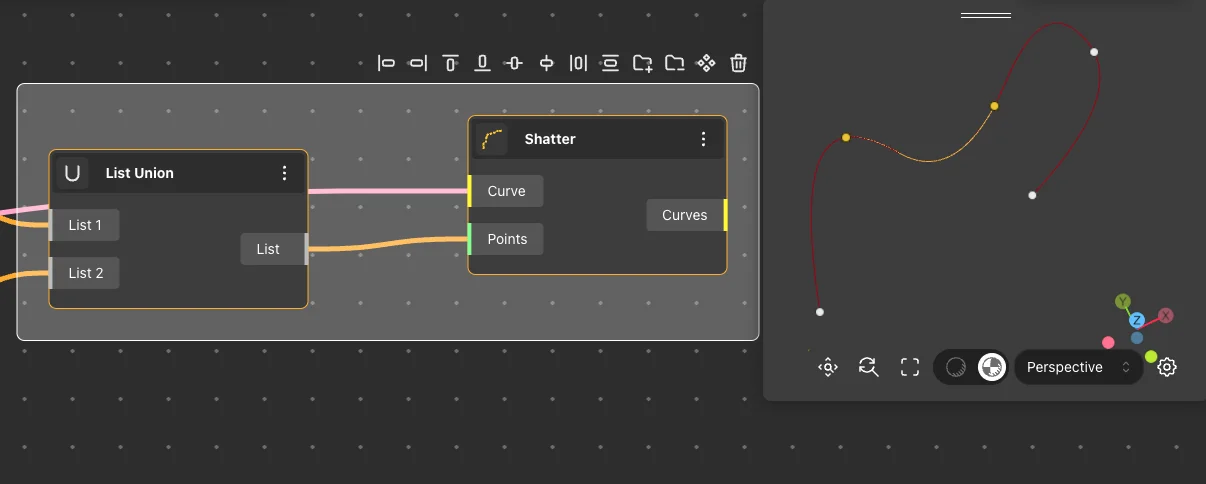
Shatter
Behavior
Cuts a curve into multiple pieces at specific parameter positions or points along the curve.
Inputs
Curve, Parameters
Outputs
Segments
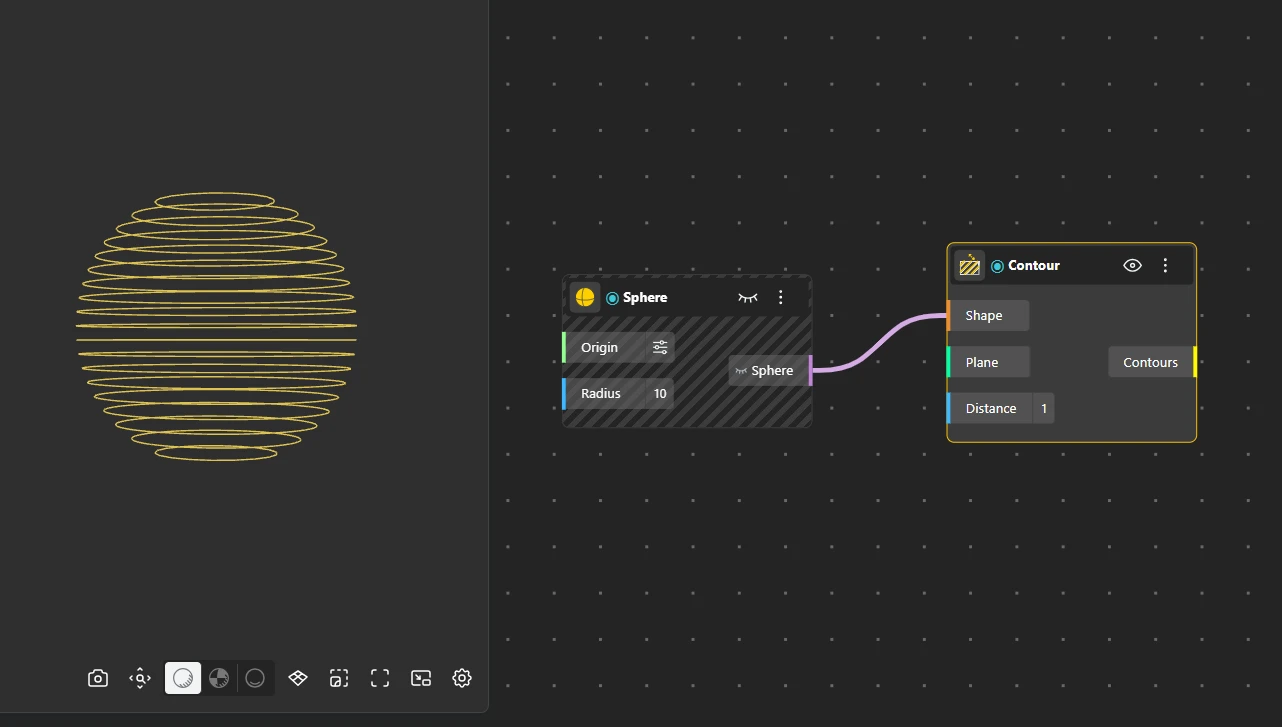
Contour
Behavior
Creates evenly spaced cross-section slices along or across geometry at regular intervals.
Inputs
Geometry, Distance
Outputs
Contours
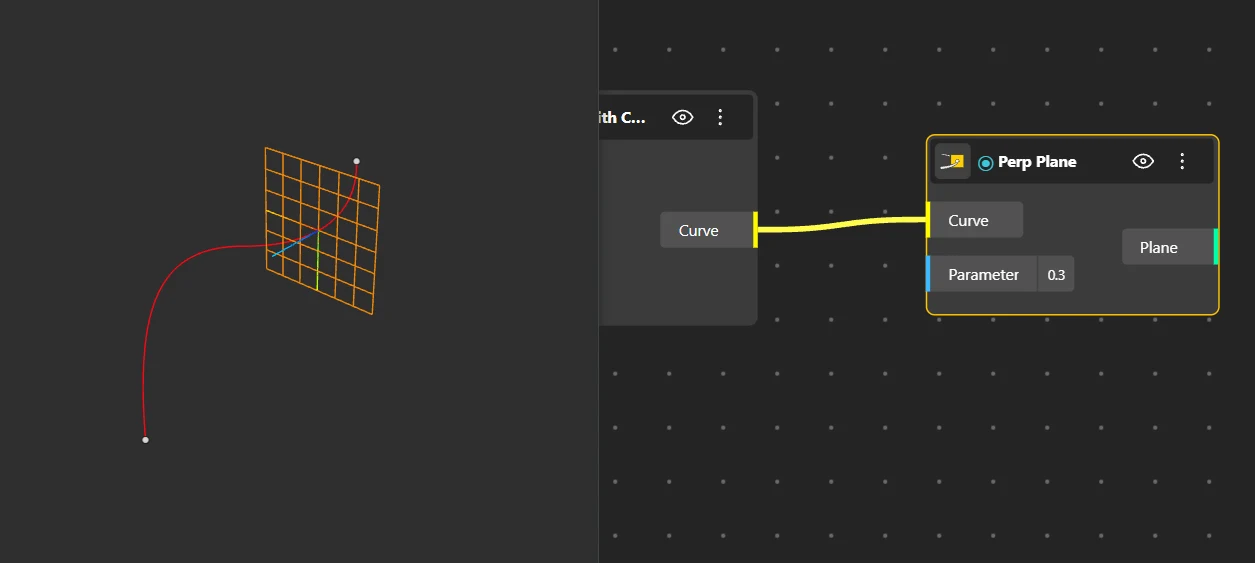
Perp Plane
Behavior
Creates a plane perpendicular to a curve at parameter t. The plane's normal aligns with the curve tangent at that point. Default: t = 0.5 (midpoint). Range 0-1. Parameter t is a position along the curve: t=0 is the start, t=0.5 is the midpoint, t=1 is the end. Useful as a construction reference for placing geometry perpendicular to a path.
Inputs
Curve, t
Outputs
Plane
Perp Planes
Behavior
Creates multiple perpendicular planes at evenly spaced intervals along a curve.
Inputs
Curve, Count
Outputs
Planes
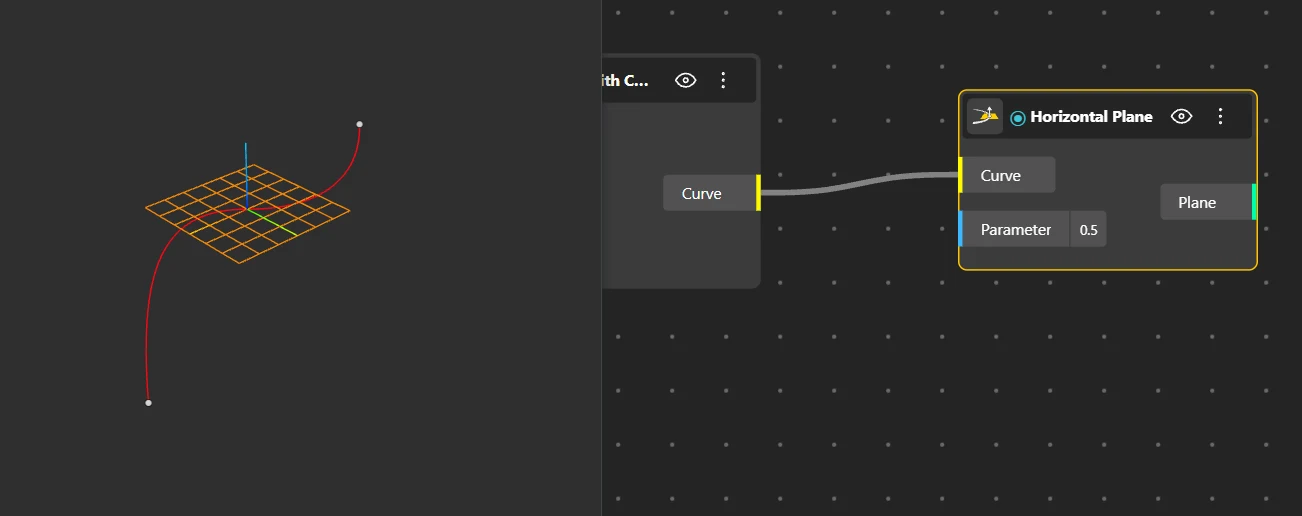
Horizontal Plane / Horizontal Planes
Behavior
Creates flat XY-aligned plane(s) at curve position(s). Single version evaluates at parameter t; plural creates multiple planes.
Inputs
Curve, t / Count
Outputs
Plane(s)
Curve Plane / Curve Planes
Behavior
Generates plane(s) aligned to the curve's local coordinate frame at the specified position(s).
Inputs
Curve, t / Count
Outputs
Plane(s)
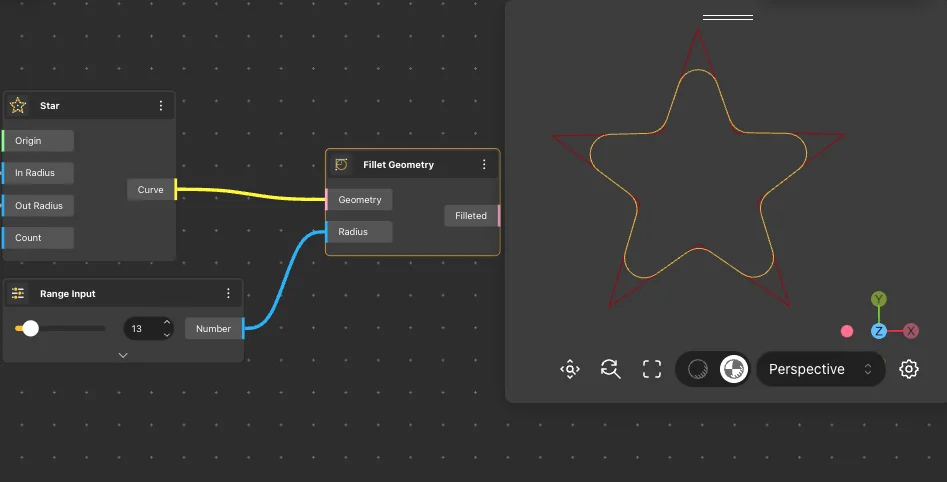
Fillet Geometry
Behavior
Creates rounded, smooth transitions between edges or curves by applying a radius-based fillet to geometry corners. Works on curves, surfaces, and solids. Default: Radius 2. The radius defines the size of the rounding - larger radius = smoother, wider fillet. If the radius exceeds the available edge length, the fillet may fail.
Inputs
Geometry, Radius
Outputs
Filleted
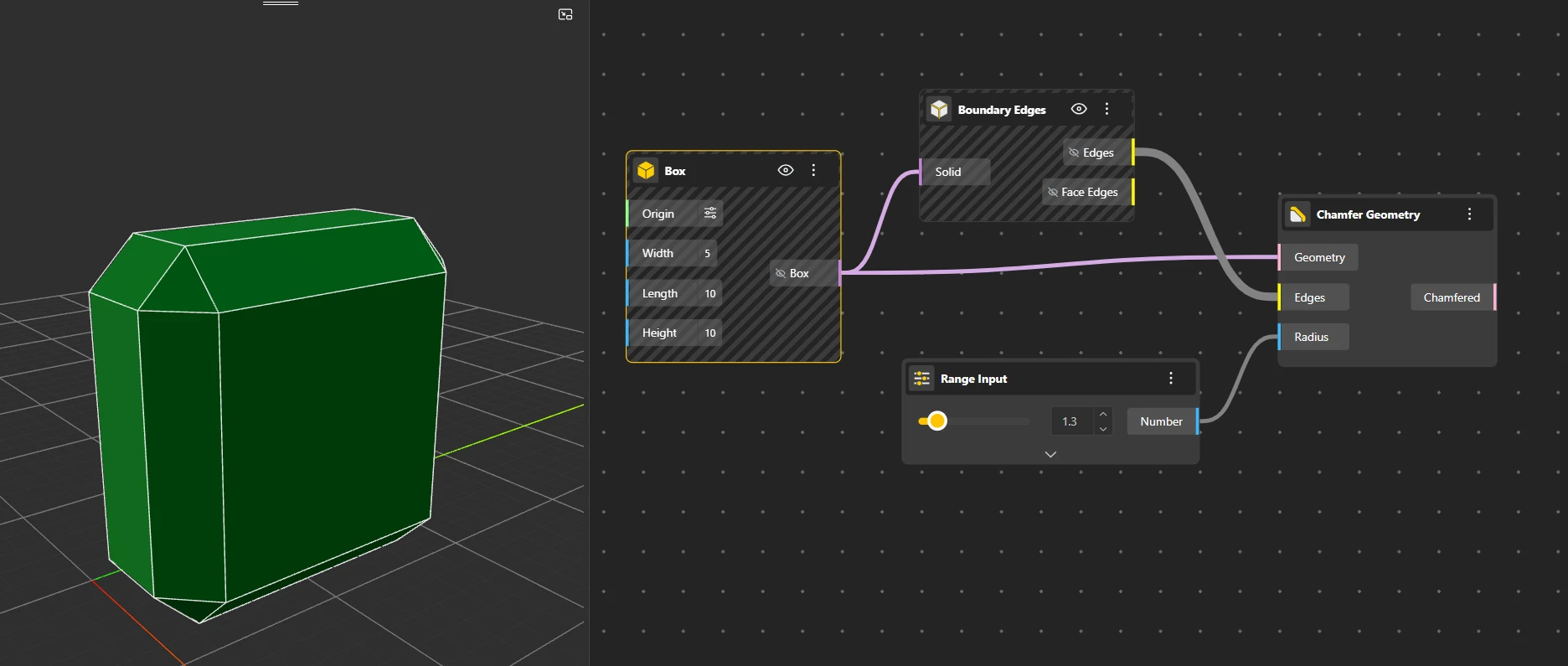
Chamfer Geometry
Behavior
Creates straight angled cuts between edges - a flat bevel instead of a round fillet.
Inputs
Geometry, Size
Outputs
Chamfered
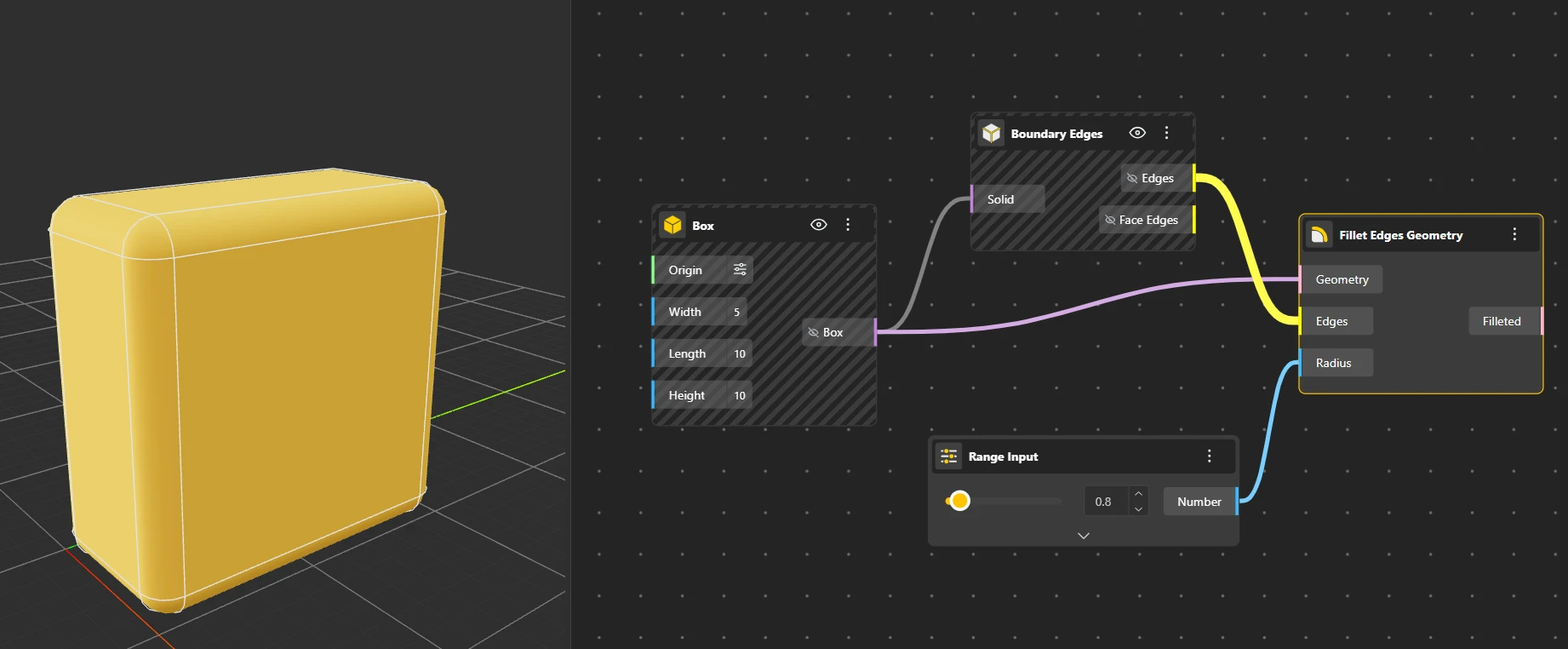
Fillet Edges Geometry
Behavior
Applies rounded fillets to all edges of a geometry object at once, rather than individual corners.
Inputs
Geometry, Radius
Outputs
Filleted
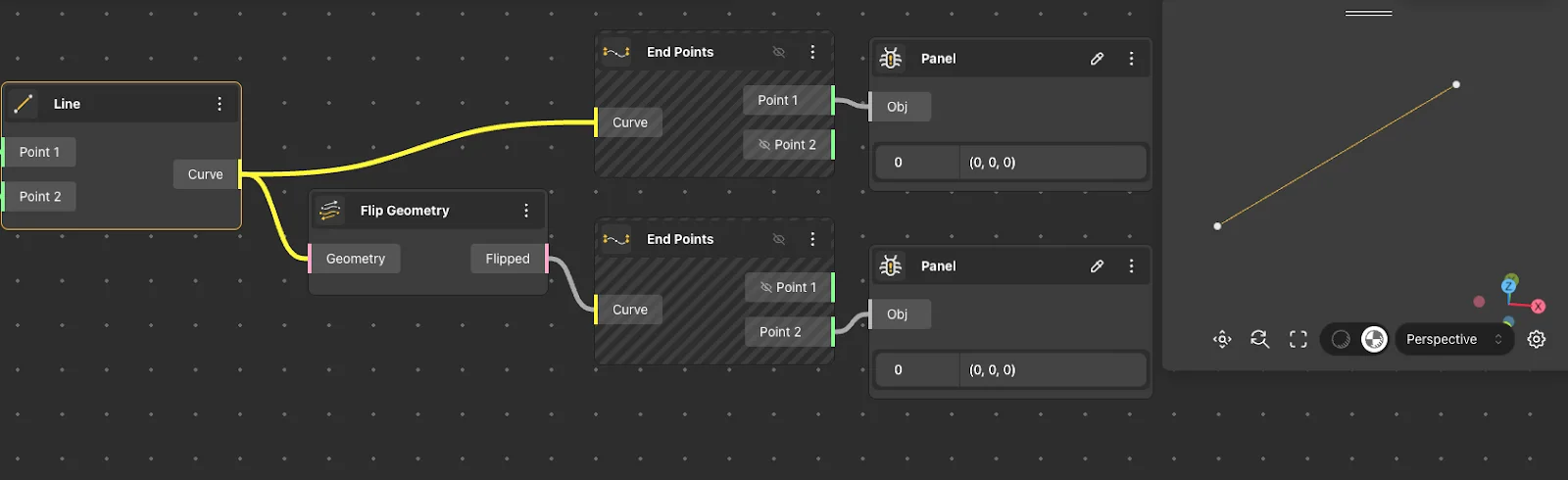
Flip Geometry
Behavior
Reverses the direction or orientation of a curve or geometry - flips normals and reverses parametric direction.
Inputs
Geometry
Outputs
Flipped
Geometry Reorient
Behavior
Moves and aligns geometry to match a new reference plane - combines translation and rotation in one operation.
Inputs
Geometry, Plane
Outputs
Reoriented
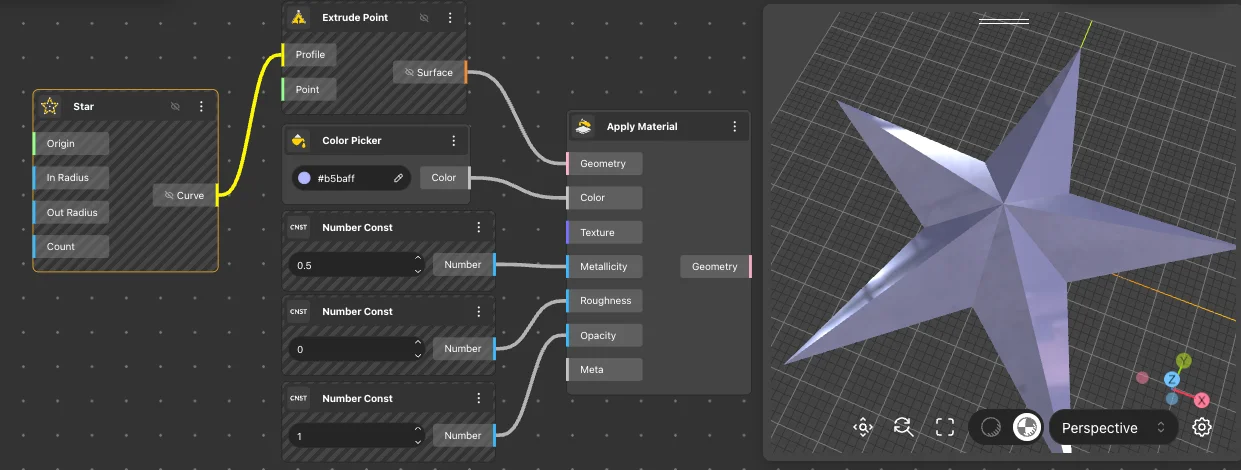
Apply Material
Behavior
Assigns visual appearance properties to geometry - color, metallicity, roughness, opacity, and texture. The geometry shape is unchanged; only its rendering appearance is modified. Metallicity 0 = non-metal (plastic, clay), 1 = fully metallic (steel, gold). Roughness 0 = glossy/mirror, 1 = matte/diffused. Opacity 0 = transparent, 1 = fully opaque.
Inputs
Geometry, Color, Metallicity, Roughness, Opacity, Texture
Outputs
Materialized
Pairs With
Color Picker, Texture, Render