Surfaces
Nodes for creating, analyzing, and modifying surfaces - the 2D shells that form the skin of 3D models.
27 nodes in this group
Surface Construction
Create surfaces from curves, points, or primitive parameters.
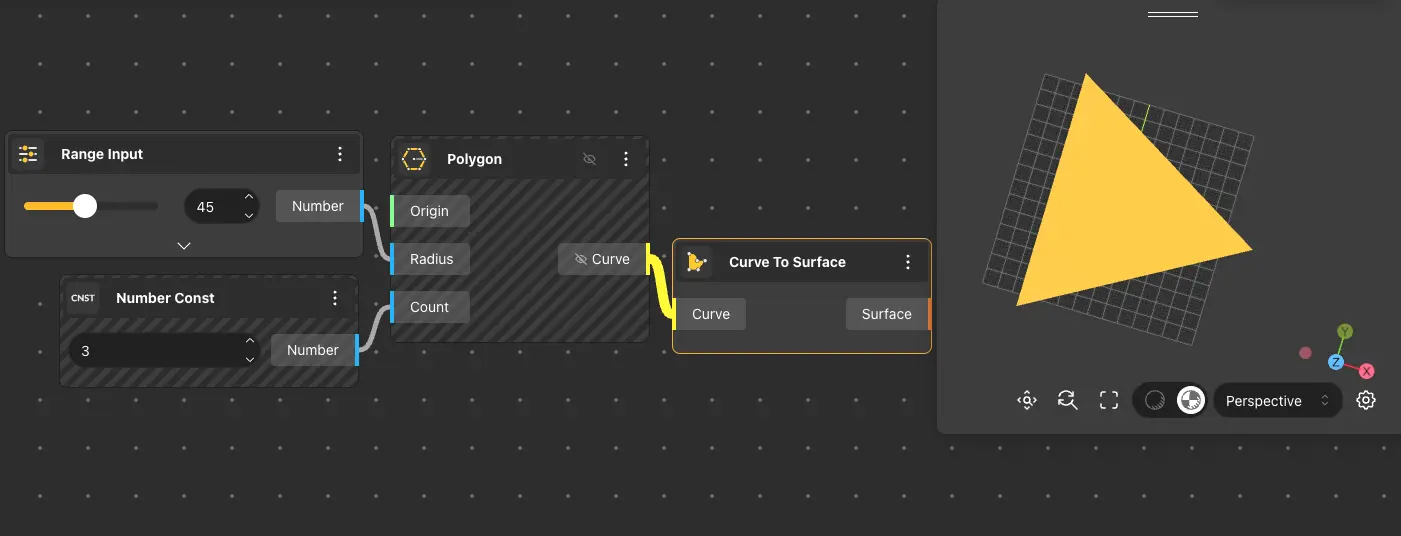
Curve To Surface
Behavior
Converts a closed planar curve into a flat surface bounded by that curve. Input curve must be closed and planar - open curves produce no output.
Inputs
Curve
Outputs
Surface
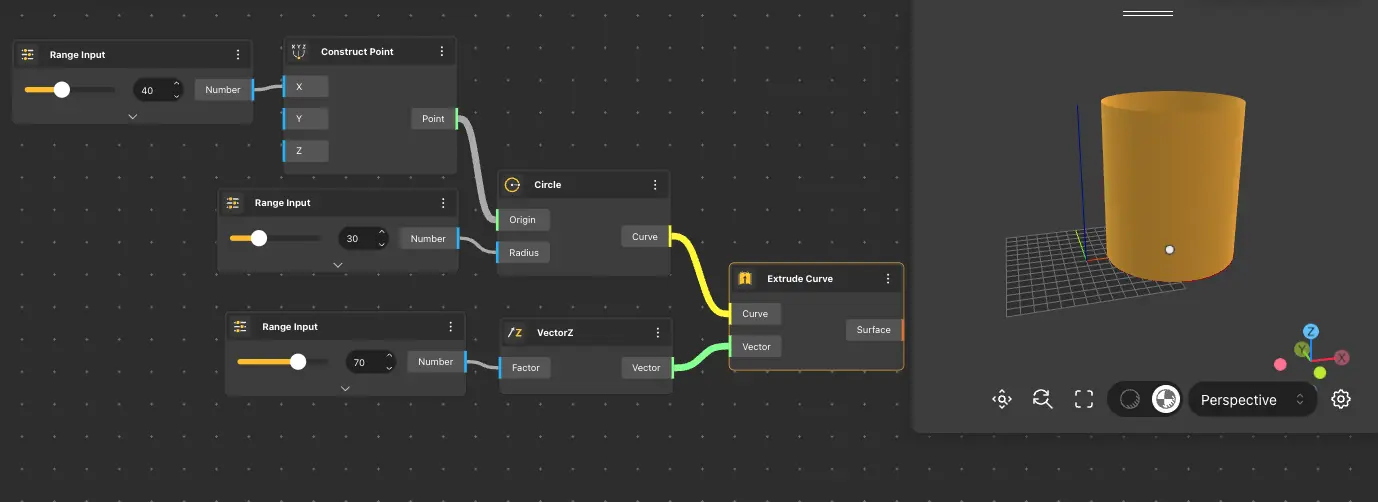
Extrude Curve
Behavior
Extrudes a profile curve along a vector to create a surface. Default: Vector {0, 0, 10}. Accepts multiple curves and vectors with flexible pairing - multiple curves extrude along the same vector, or a single curve produces separate extrusions for each connected vector direction.
Inputs
Curve, Vector
Outputs
Surface
Pairs With
Line, Rectangle, VectorZ
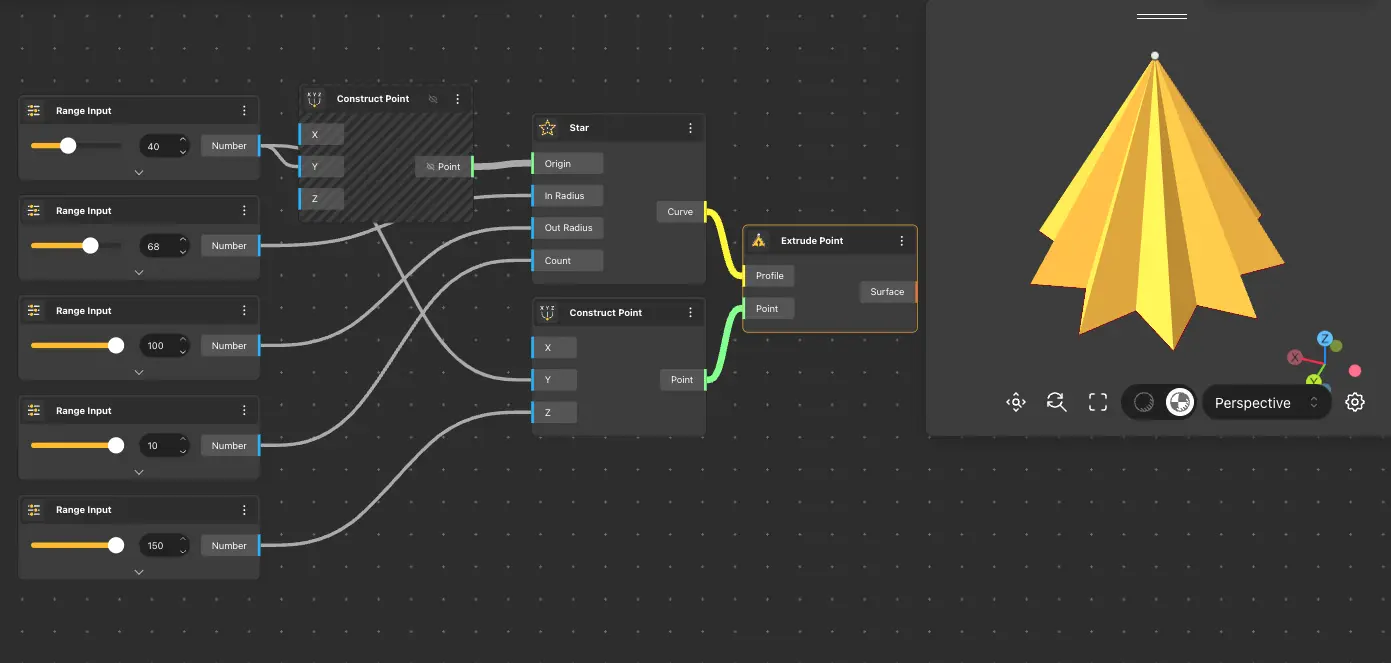
Extrude Point
Behavior
Extends a curve toward a specified point to create a surface.
Inputs
Curve, Point
Outputs
Surface
Extrude Along
Behavior
Extrudes a profile curve along a path curve to create a surface.
Inputs
Profile, Path
Outputs
Surface
Sweep
Behavior
Creates a surface by moving a base curve along a rail curve. The profile is swept from the start to the end of the rail, maintaining its cross-section shape along the path. The base curve defines the cross-section shape, and the rail curve defines the path it follows. The output surface's quality depends on the smoothness of the rail - sharp corners in the rail produce sharp edges in the surface. For more control, use Sweep2 with two rail curves.
Inputs
Profile, Rail
Outputs
Surface
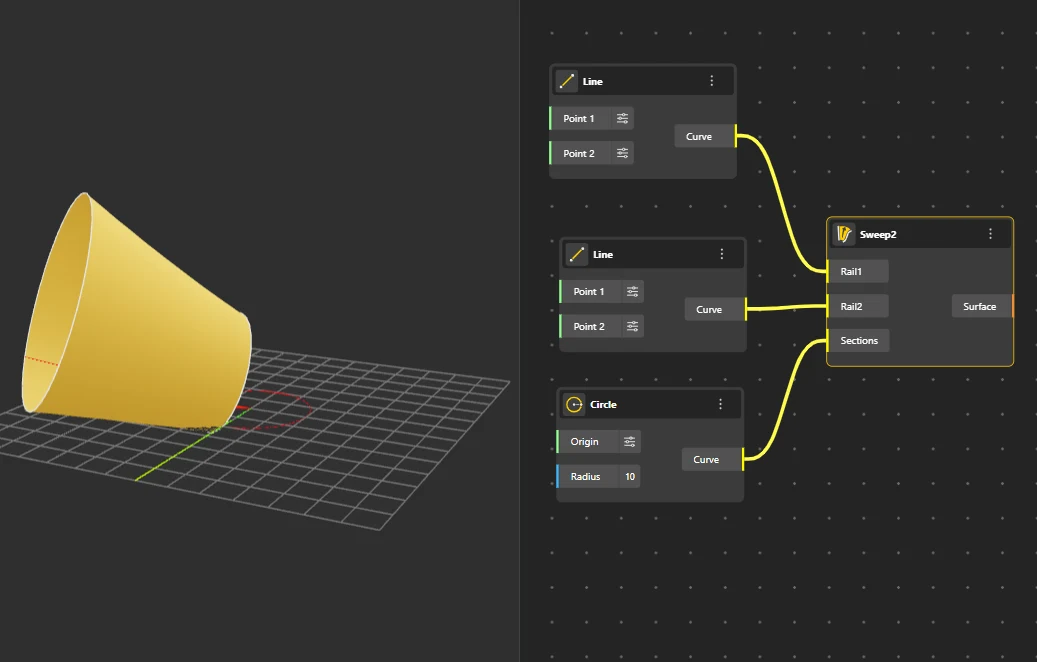
Sweep2
Behavior
Creates a surface using a profile curve guided along two rail curves. The surface interpolates between the rails, giving more control over the final shape than single-rail Sweep. All three curves (profile + two rails) must lie on different planes. The profile defines the cross-section, while the two rails control how that cross-section transitions along the path. Produces more predictable results than Sweep on complex paths.
Inputs
Profile, Rail 1, Rail 2
Outputs
Surface
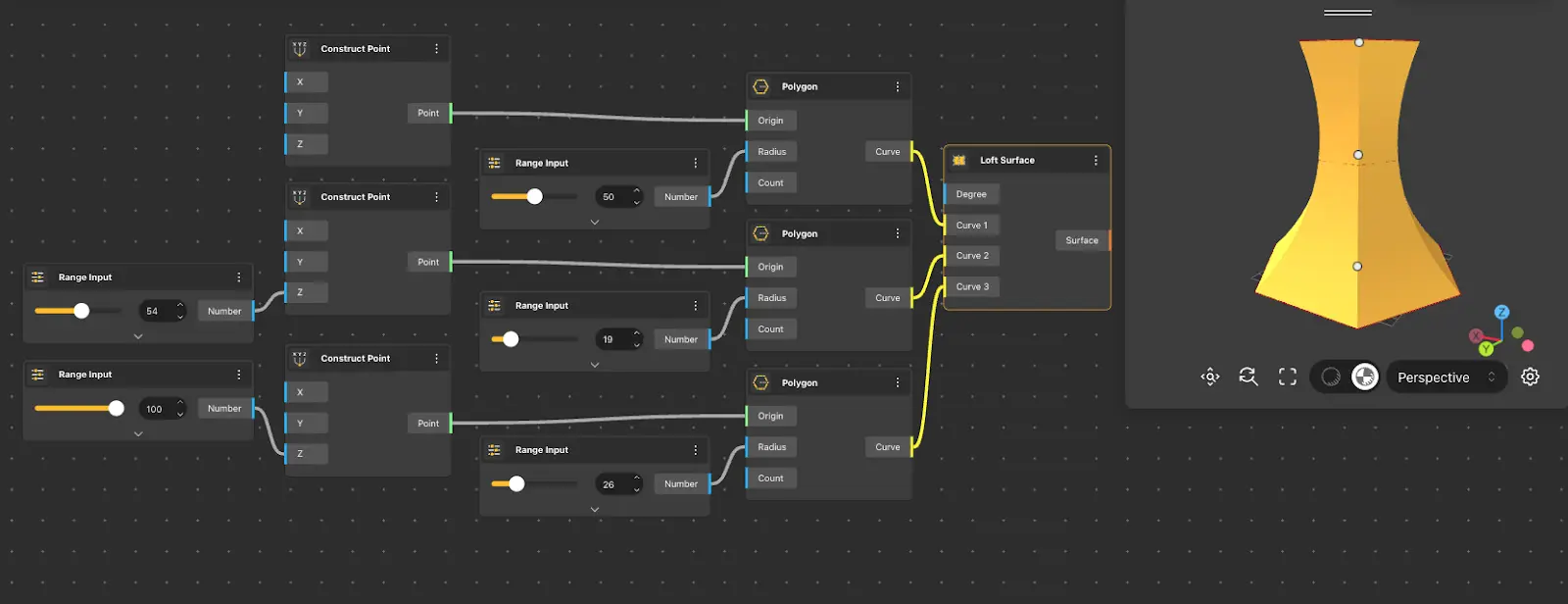
Loft Surface
Behavior
Creates a lofted surface that interpolates through a set of section curves, producing a smooth skin that passes through all provided profiles. Default: Degree 2. Minimum 2 section curves required. Additional section curves are added via the port menu's “add port” function. The Degree parameter controls surface smoothness. For advanced control over continuity and parametrization, use Loft Advanced instead.
Inputs
Curves
Outputs
Surface
Loft Advanced
Behavior
Creates a loft surface with additional control over continuity, tangency, and surface parameters.
Inputs
Curves, Options
Outputs
Surface
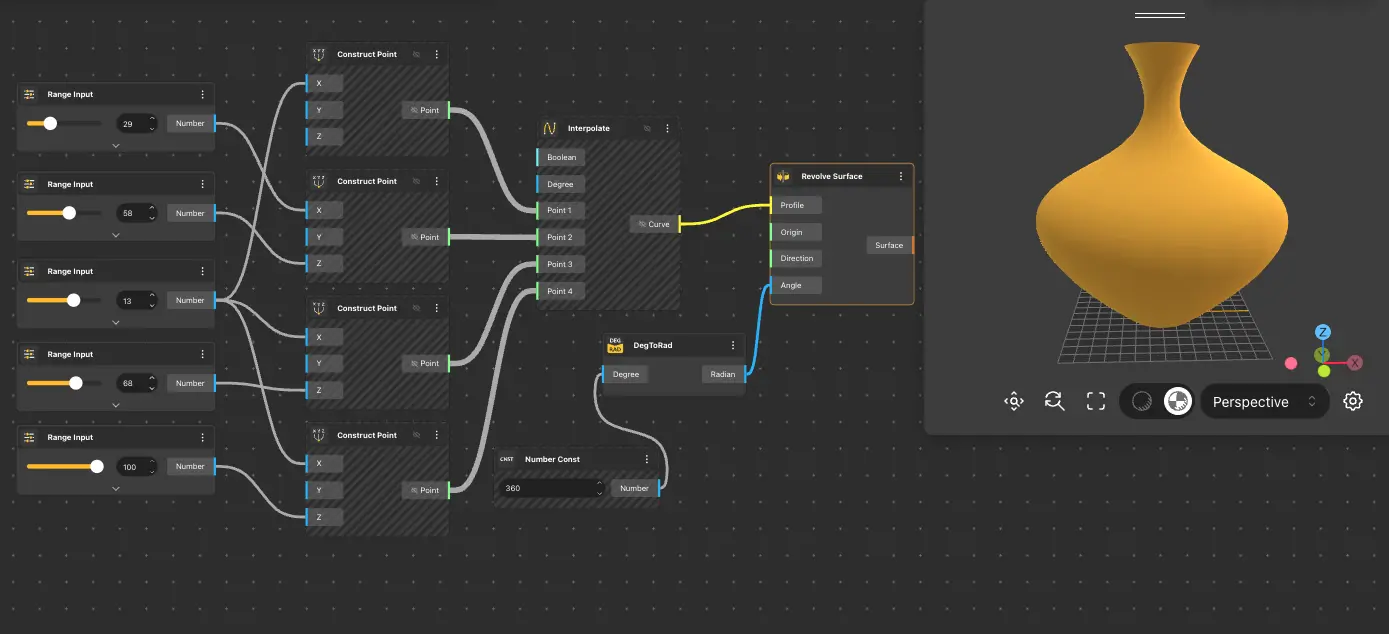
Revolve Surface
Behavior
Creates a surface by revolving a profile curve around an axis origin and direction through a defined angle. Default: Origin {0,0,0}, Direction {0,0,1} (Z axis), Angle π radians (half revolution).
Inputs
Curve, Axis, Point, Angle
Outputs
Surface
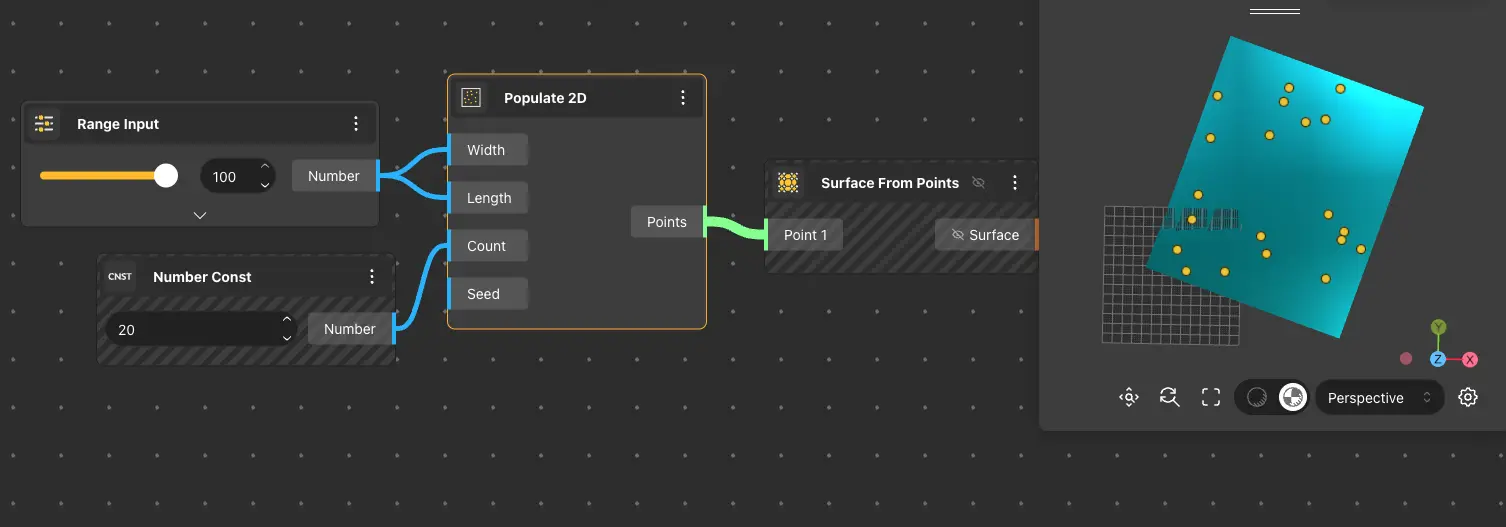
Surface From Points
Behavior
Generates a surface from a grid of points. Points define the surface's control net.
Inputs
Points
Outputs
Surface
Surface From Curves
Behavior
Generates a surface from a network of curves.
Inputs
Curves
Outputs
Surface
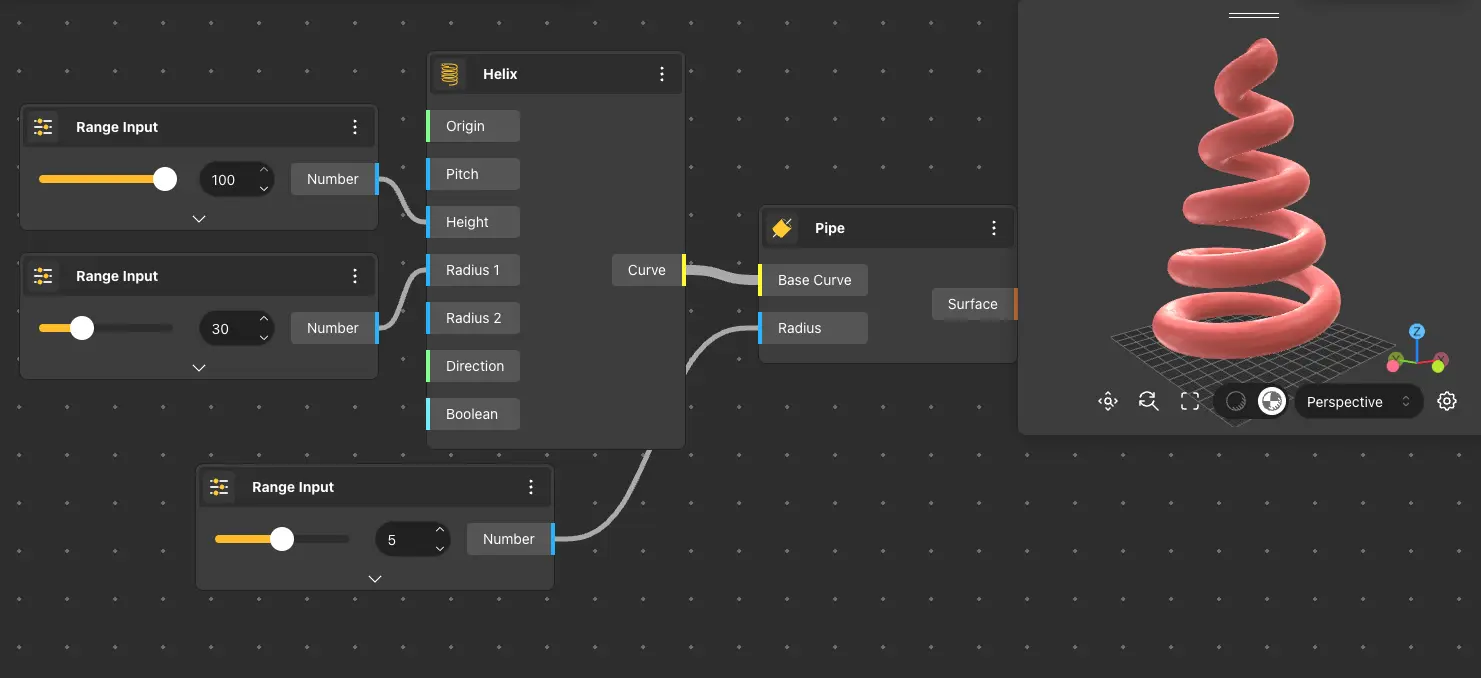
Pipe
Behavior
Creates a tubular surface by sweeping a circular cross-section along a base curve. Default: Radius 10.
Inputs
Curve, Radius
Outputs
Surface
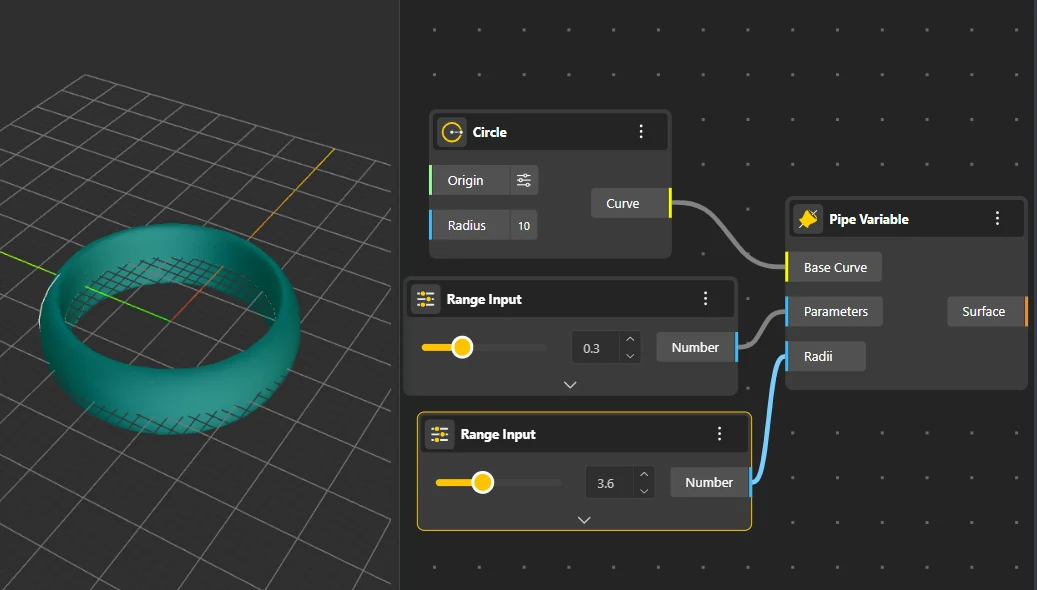
Pipe Variable
Behavior
Creates a tubular surface whose radius changes along the curve. Define radius values at specific positions (0-1 parameters) along the path for tapered or organic tube shapes. The Parameters input takes a list of positions (0-1 range) and the Radii input takes corresponding radius values at each position. A pipe with Parameters {0, 0.5, 1} and Radii {5, 10, 3} starts thin, widens at the middle, and narrows at the end.
Inputs
Curve, Radii
Outputs
Surface
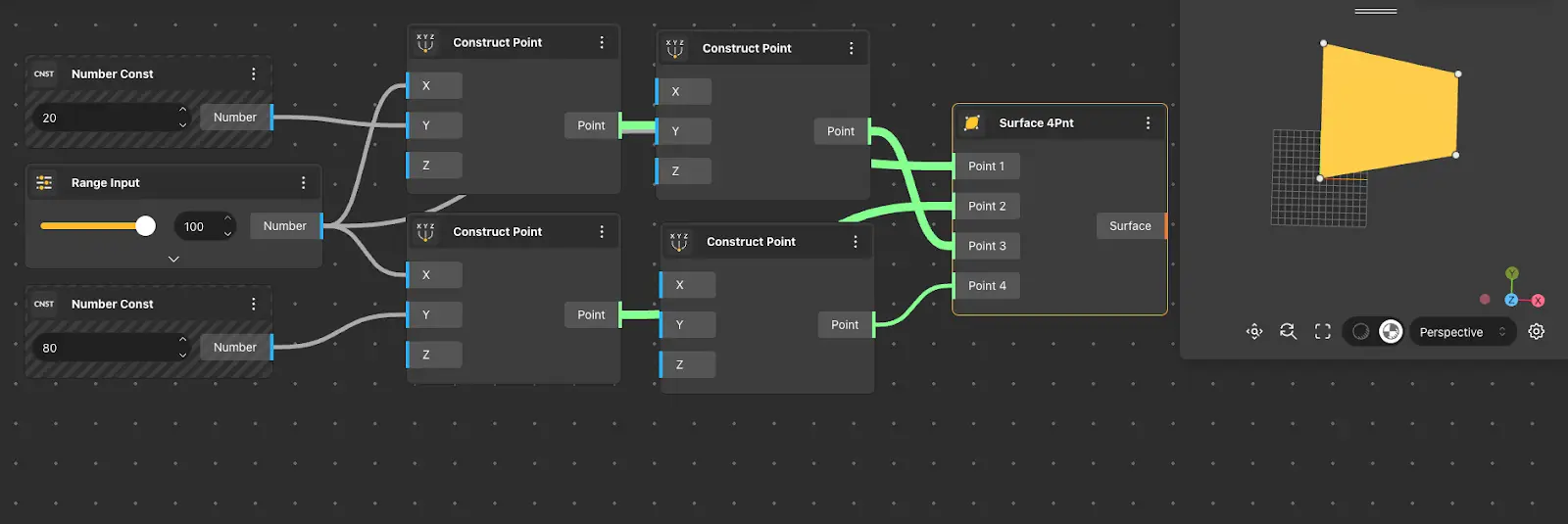
Surface 4Pnt
Behavior
Constructs a surface from four corner points.
Inputs
P1, P2, P3, P4
Outputs
Surface
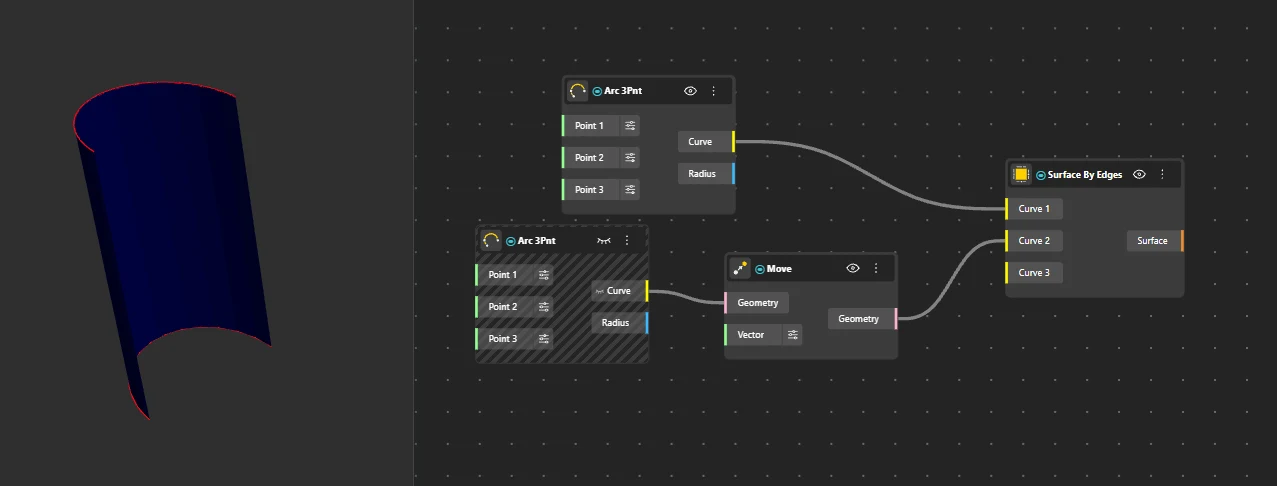
Surface By Edges
Behavior
Constructs a surface bounded by edge curves.
Inputs
Edges
Outputs
Surface
Sum Surface
Behavior
Creates a surface by summing two curves - the cross-product surface of two profile curves.
Inputs
Curve A, Curve B
Outputs
Surface
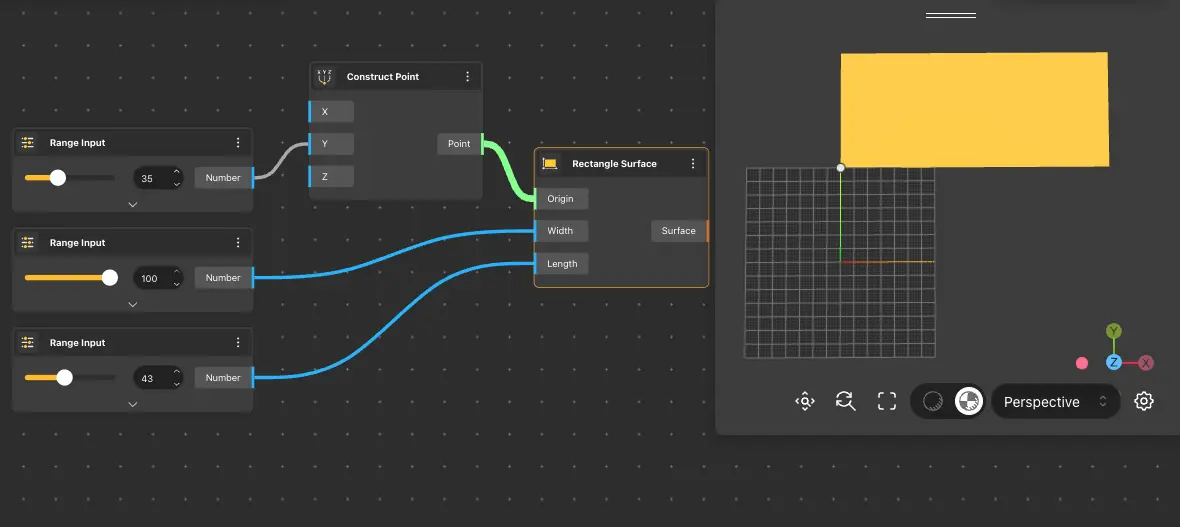
Rectangle Surface
Behavior
Creates a flat rectangular surface with adjustable origin, width, and length.
Inputs
Origin, Width, Length
Outputs
Surface
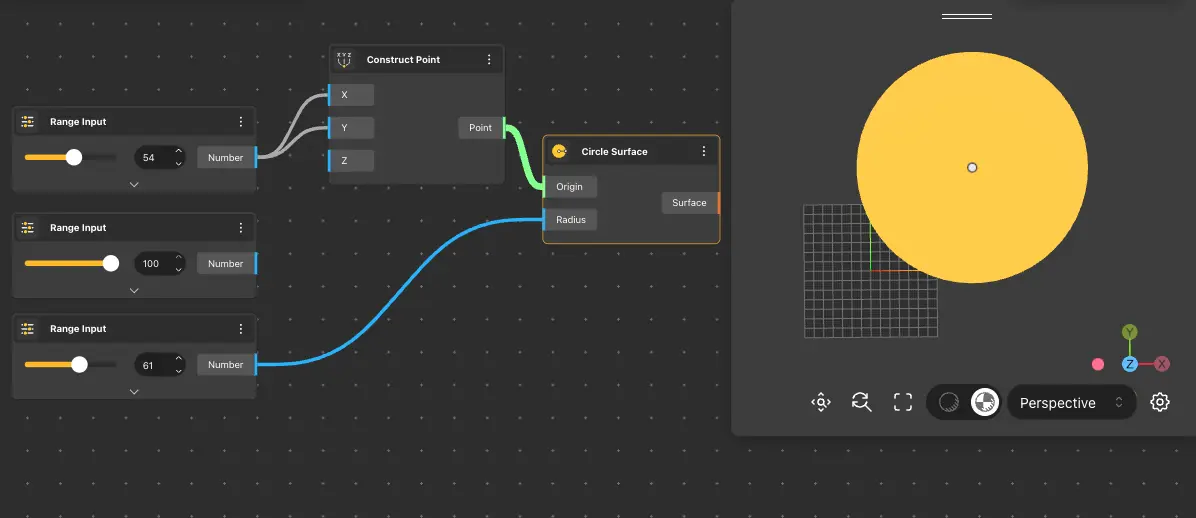
Circle Surface
Behavior
Creates a flat circular surface with adjustable origin and radius.
Inputs
Origin, Radius
Outputs
Surface
Surface Analysis
Inspect surface area, edges, isocurves, and UV points.
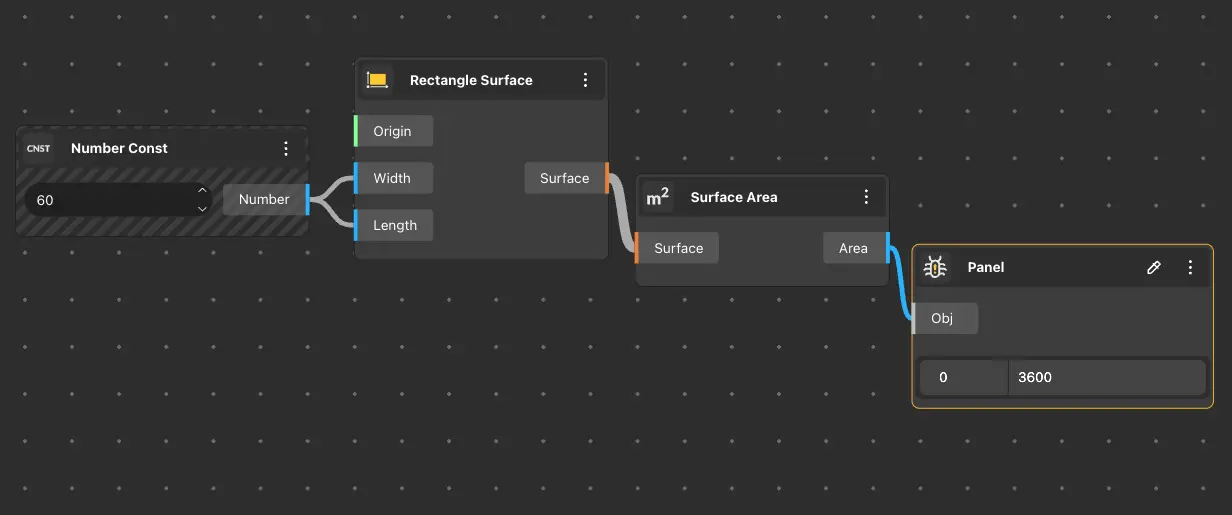
Surface Area
Behavior
Returns the area of the input surface as a numerical value.
Inputs
Surface
Outputs
Area
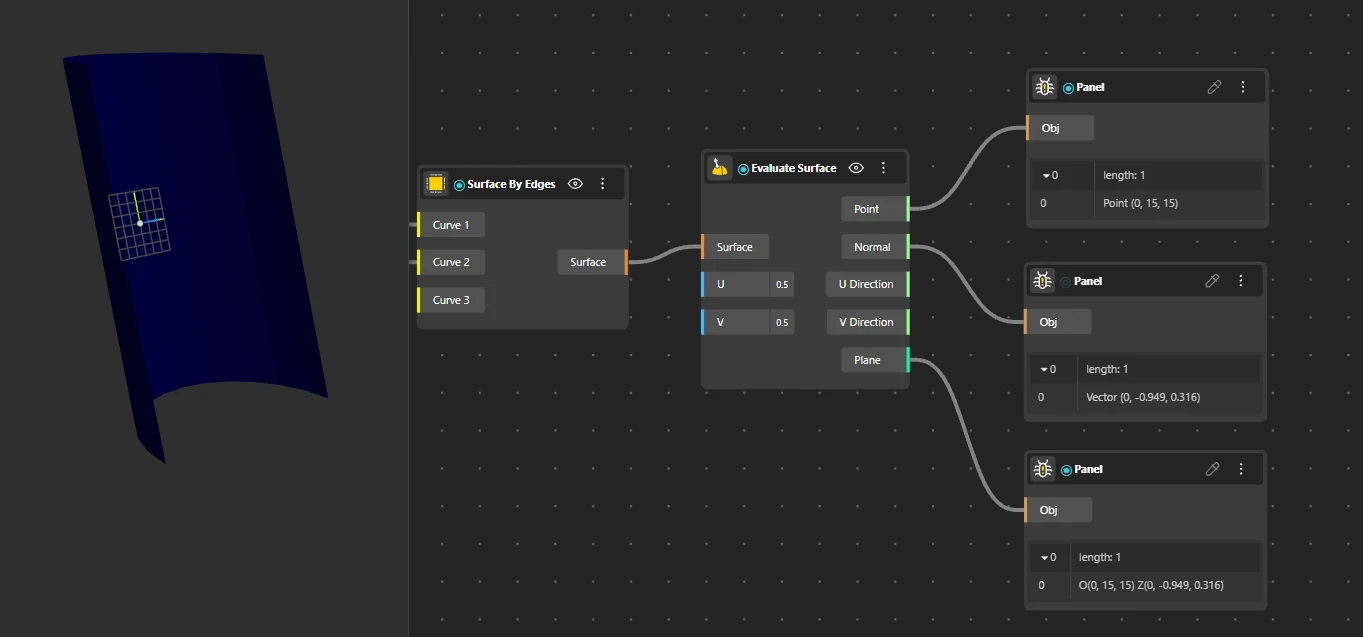
Evaluate Surface
Behavior
Evaluates a surface at UV parameters, returning the point and normal at that location.
Inputs
Surface, U, V
Outputs
Point, Normal
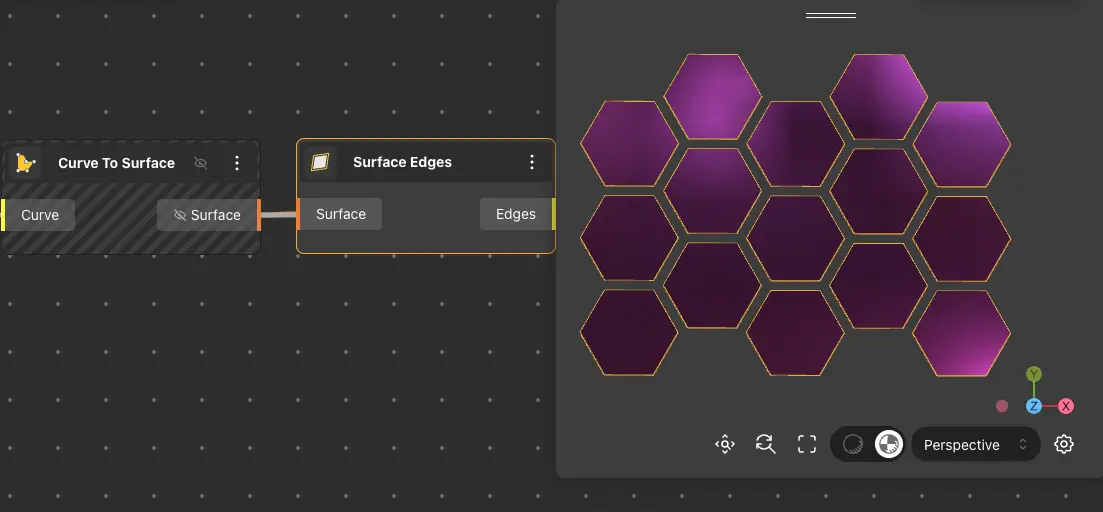
Surface Edges
Behavior
Extracts the boundary edges of a surface as curves.
Inputs
Surface
Outputs
Edges
Surface Iso Curves
Behavior
Extracts isocurves (constant-U or constant-V lines) from a surface at specified parameters.
Inputs
Surface, Parameters
Outputs
Iso Curves
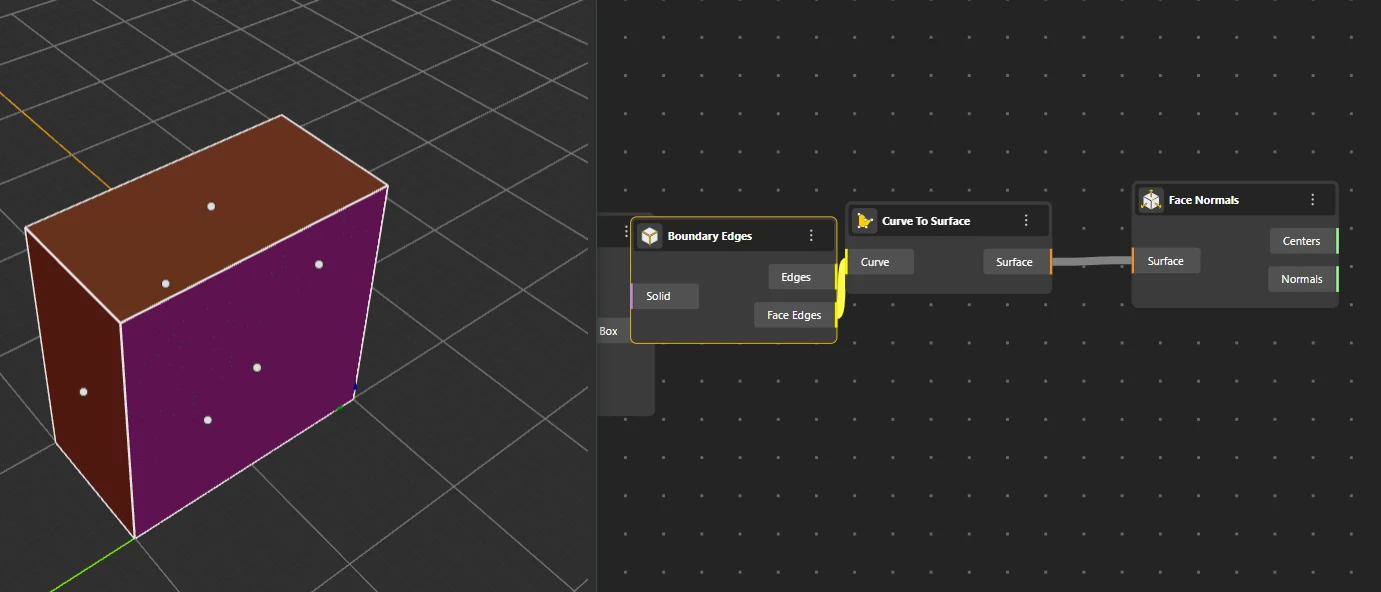
Face Normals
Behavior
Returns the normal vectors at face centers of a surface.
Inputs
Surface
Outputs
Normals, Centers
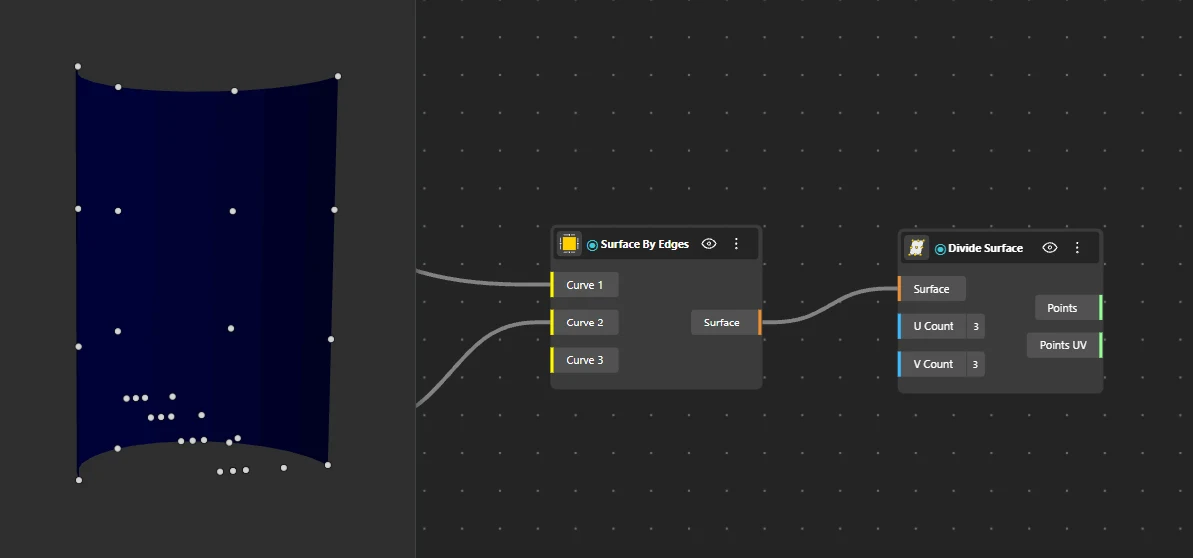
Divide Surface
Behavior
Splits a surface into a grid of points at regular UV intervals. The U and V count parameters control how many divisions in each parametric direction. U Count 5 and V Count 3 produces a 5×3 grid of 15 points across the surface. The points follow the surface curvature - on a sphere, they're evenly distributed across the spherical surface. Commonly used for patterning, paneling input, or placing objects at surface grid positions.
Inputs
Surface, U Count, V Count
Outputs
Points
Surface Modification
Cap, offset, and thicken surfaces into usable shells and solids.
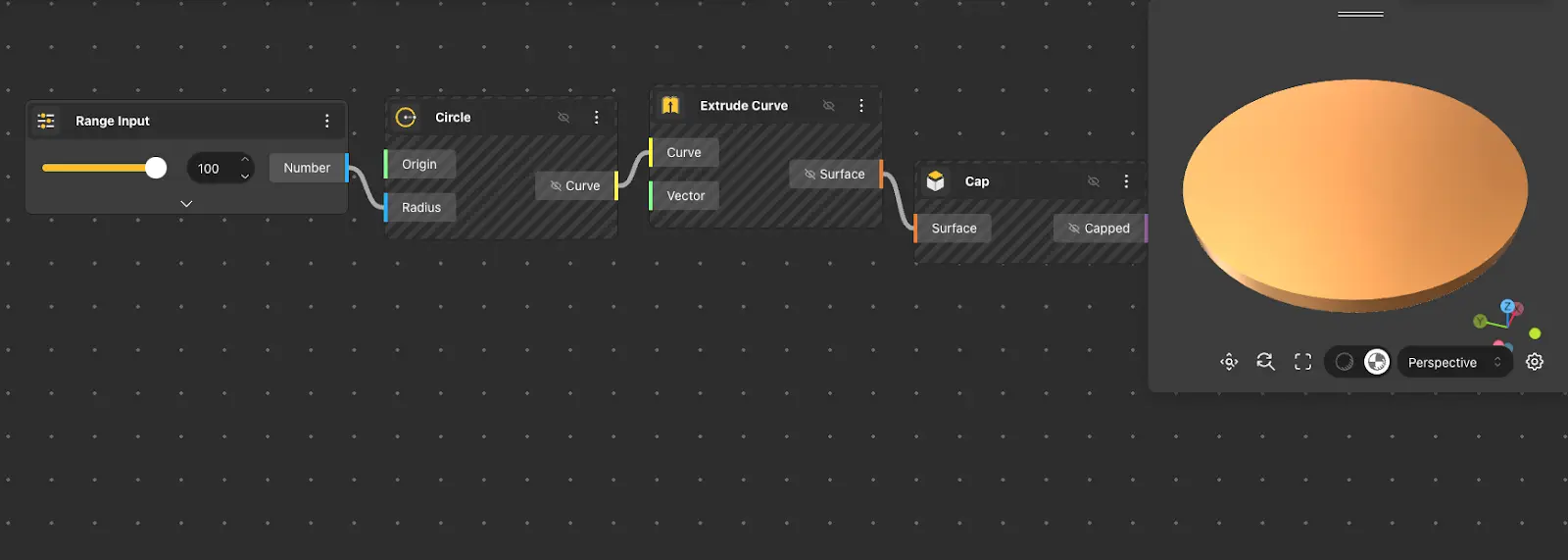
Cap
Behavior
Closes all planar holes in a Brep by capping open edges with flat surfaces, converting an open shell into a sealed solid. Automatically identifies and fills all planar openings. Non-planar openings are ignored. Output becomes a Solid type suitable for Boolean operations.
Inputs
Surface
Outputs
Capped
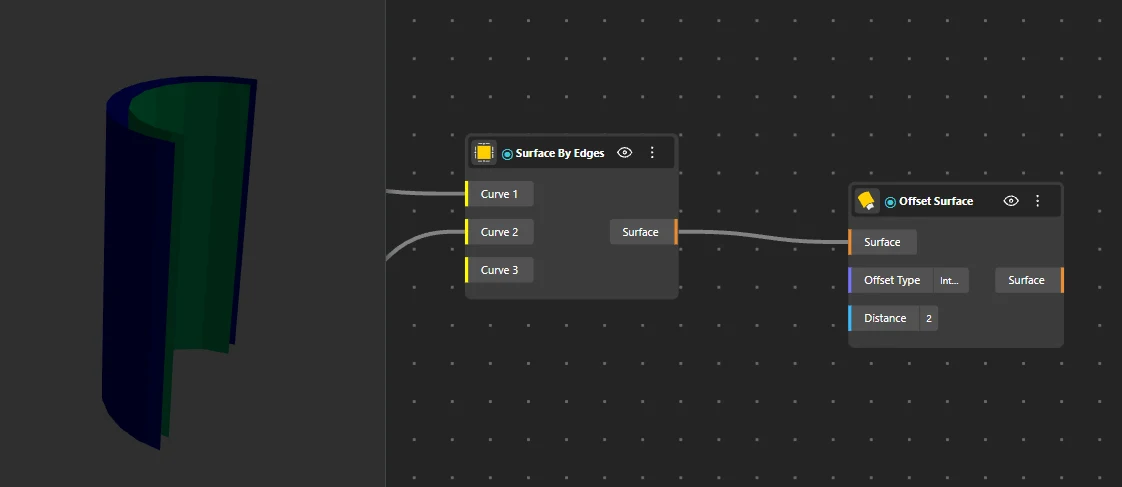
Offset Surface
Behavior
Creates a parallel copy of the surface offset by a specified distance along its face normals. Positive distance offsets outward (along normal direction), negative offsets inward. Three offset types: Arc (smooth rounded transitions), Intersection (sharp corners where offset segments meet), Tangent (smooth non-circular corners). Hide the original surface for a clearer preview of the offset result.
Inputs
Surface, Distance
Outputs
Offset
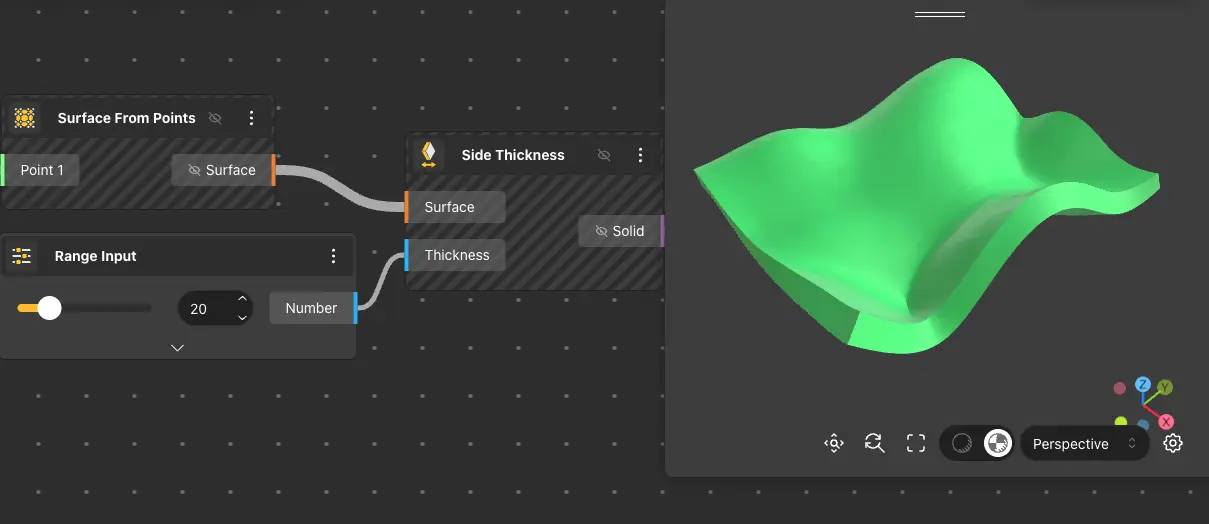
Side Thickness
Behavior
Converts a surface into a solid by adding uniform wall thickness. Takes a 2D shell and produces a 3D solid with walls of specified distance. Default: Thickness 2.
Inputs
Surface, Thickness
Outputs
Solid
Pairs With
Loft Surface, Extrude Curve