Input
Nodes for providing user-controlled data inputs - numbers, text, booleans, colors, images, and interactive controls for parametric models.
18 nodes in this group
Constants
Fixed values that remain hidden in Configurator mode. Used internally to set parameters that should not be user-adjustable.
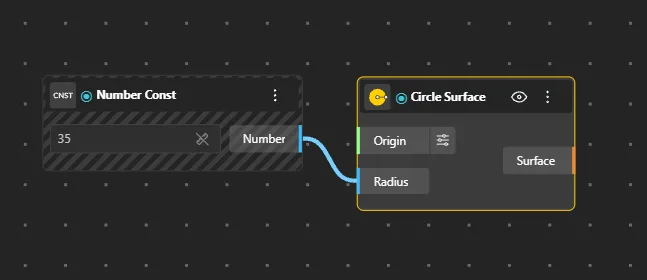
Number Const
Behavior
Provides a constant numerical value as input data for other nodes. Hidden by default in Configurator mode - used for fixed parameters that should not be exposed to end users. Default: 0. Accepts any real number. Unlike Range Input, this node has no slider or min/max bounds. The value is set directly in the node properties and remains fixed during configurator interaction.
Inputs
None
Outputs
Number
Pairs With
Addition, Construct Point, Line
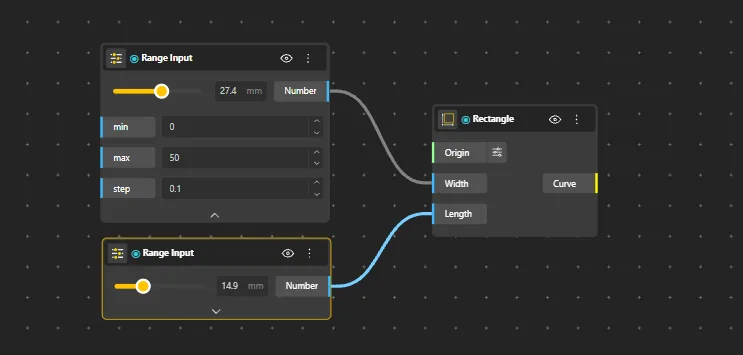
Range Input
Behavior
Returns a variable number controlled via an interactive slider. The slider has configurable minimum, maximum, and step values. Appears as a slider control in Configurator mode. Default: Min 0, Max 10, Step 0.1. Output: 0. Value can be changed by dragging the slider, using keyboard arrow keys to increment/decrement, or typing directly into the input field. Value is always clamped within the configured min-max interval.
Inputs
Min, Max, Step
Outputs
Number
Pairs With
Circle, Rectangle, Linear Array
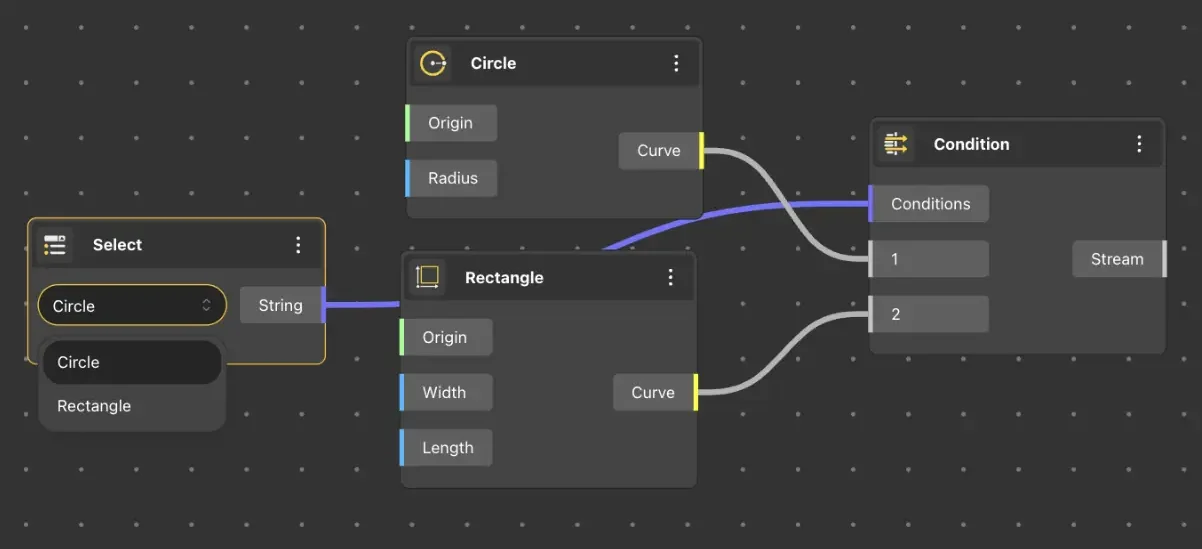
Select
Behavior
Returns a selected value from a dropdown list of options. Each option is a name-value pair entered in the node's bottom panel. Appears as a dropdown selector in Configurator mode. Default: empty option list. Output: empty string. Output is always a string type. If a numeric result is needed, connect the output to a StringToNumber convertor. Add options by opening the node's bottom panel and clicking '+' to create new value-label pairs.
Inputs
Options
Outputs
String
Pairs With
Condition, StringToNumber
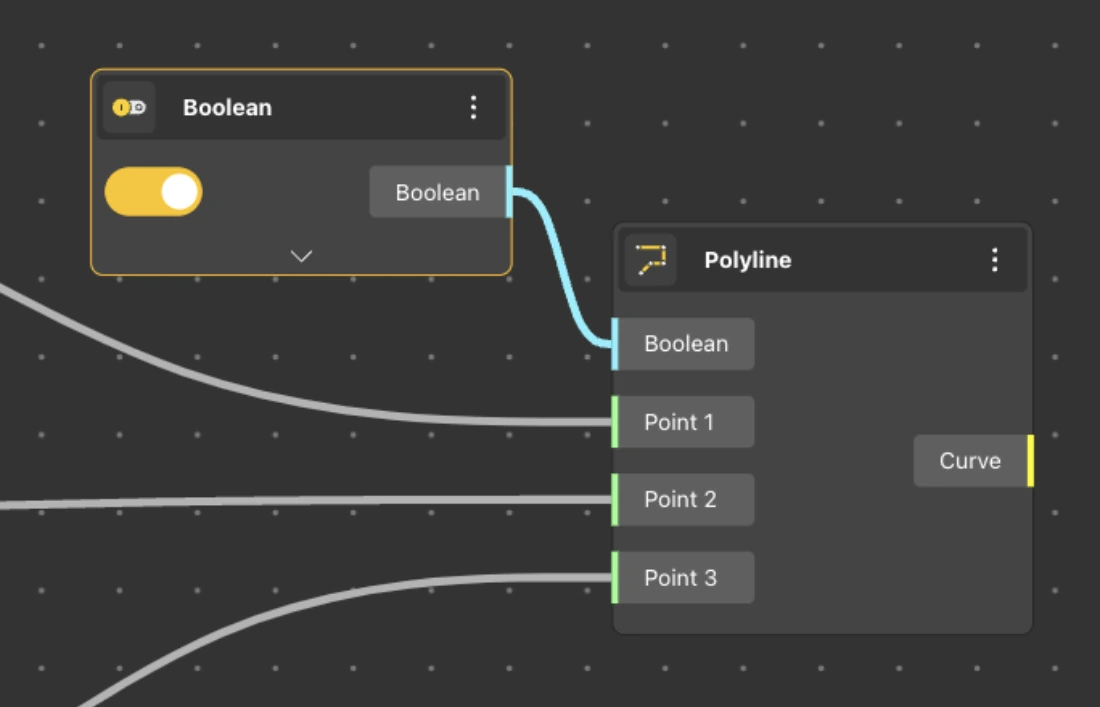
Boolean
Behavior
Returns a boolean value via a toggle switch. Outputs true when checked, false when unchecked. Appears as a toggle switch in Configurator mode. Default: true. Supports custom on/off labels inside the switch. The switch can display custom text labels for each state (configured via onLabel and offLabel properties). Commonly wired into Condition or Stream Filter nodes to toggle geometry visibility or switch between design variants.
Inputs
None
Outputs
Boolean
Pairs With
Condition, Stream Filter, BooleanToNumber
Color Picker
Behavior
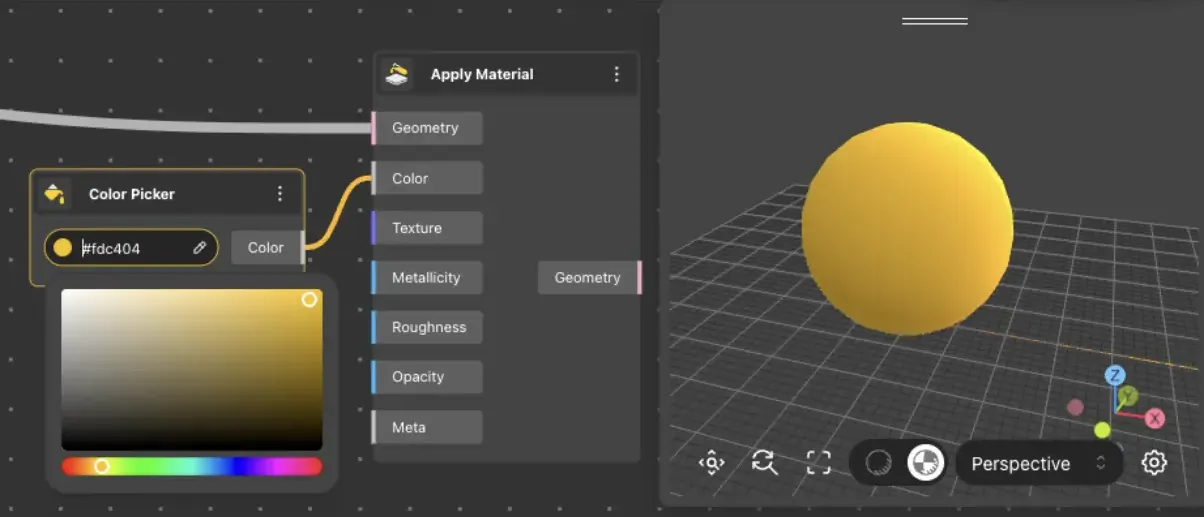
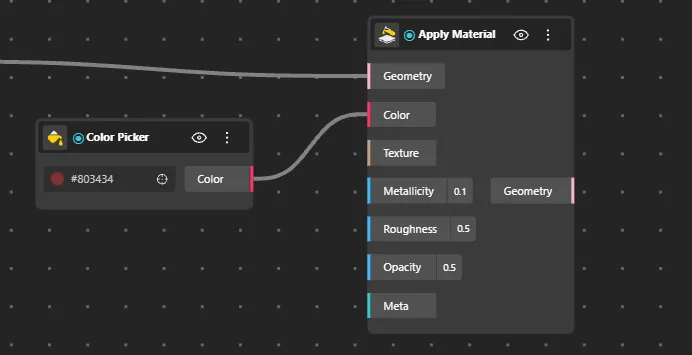
Provides a selected color value. Color can be set via hex code or a visual color picker popup. Appears as a color swatch in Configurator mode. Default: #FFFFFF (white). Output is a color value that can be fed into Apply Material or other nodes that accept color input. Supports hex input for precise brand color matching.
Inputs
None
Outputs
Color
Pairs With
Apply Material
Text Input
Behavior
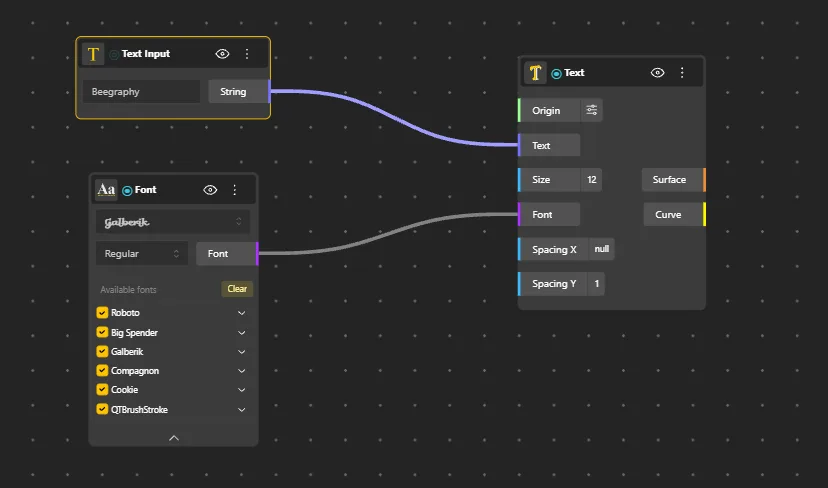
Accepts a single-line text value as input. Designed for text manipulation - the output string can be passed to Text nodes for 3D text geometry or used in logic. Default: empty string. Single-line only. For multi-line text, use Text Area Input instead.
Inputs
None
Outputs
String
Pairs With
Text, Concatenate, StringToNumber
Text Area Input
Behavior
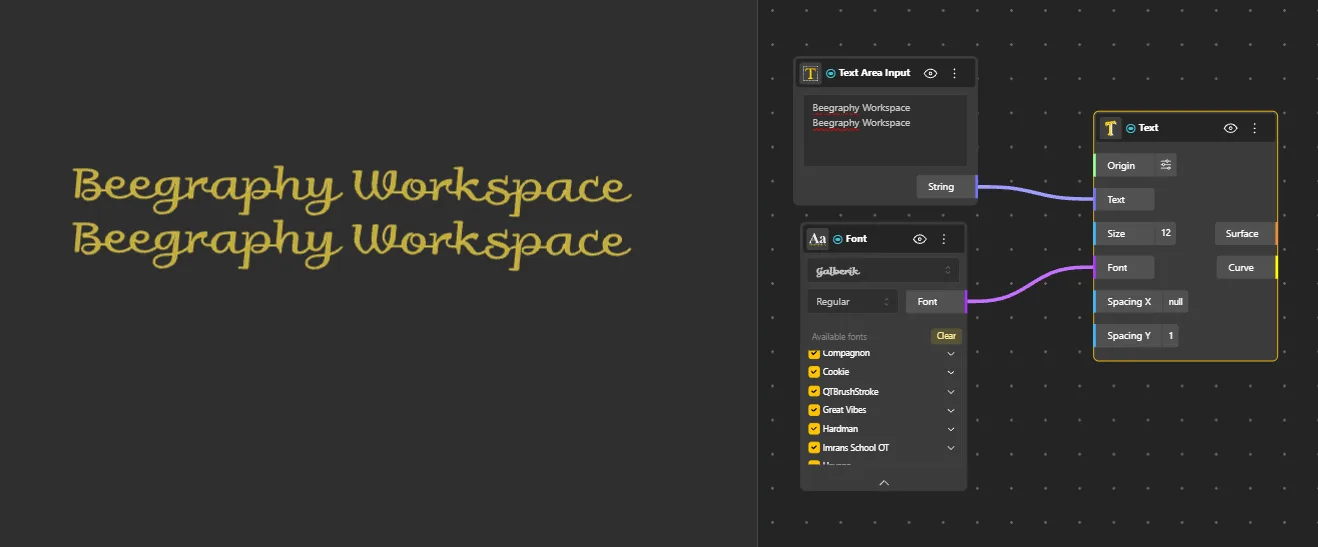
Accepts multi-line text values as input. Extended text input for longer content such as descriptions, notes, or multi-line labels. Default: empty string. Supports line breaks and paragraph formatting. For single-line input, use Text Input instead.
Inputs
None
Outputs
String
Pairs With
Text, Concatenate
Rich Text Editor
Behavior
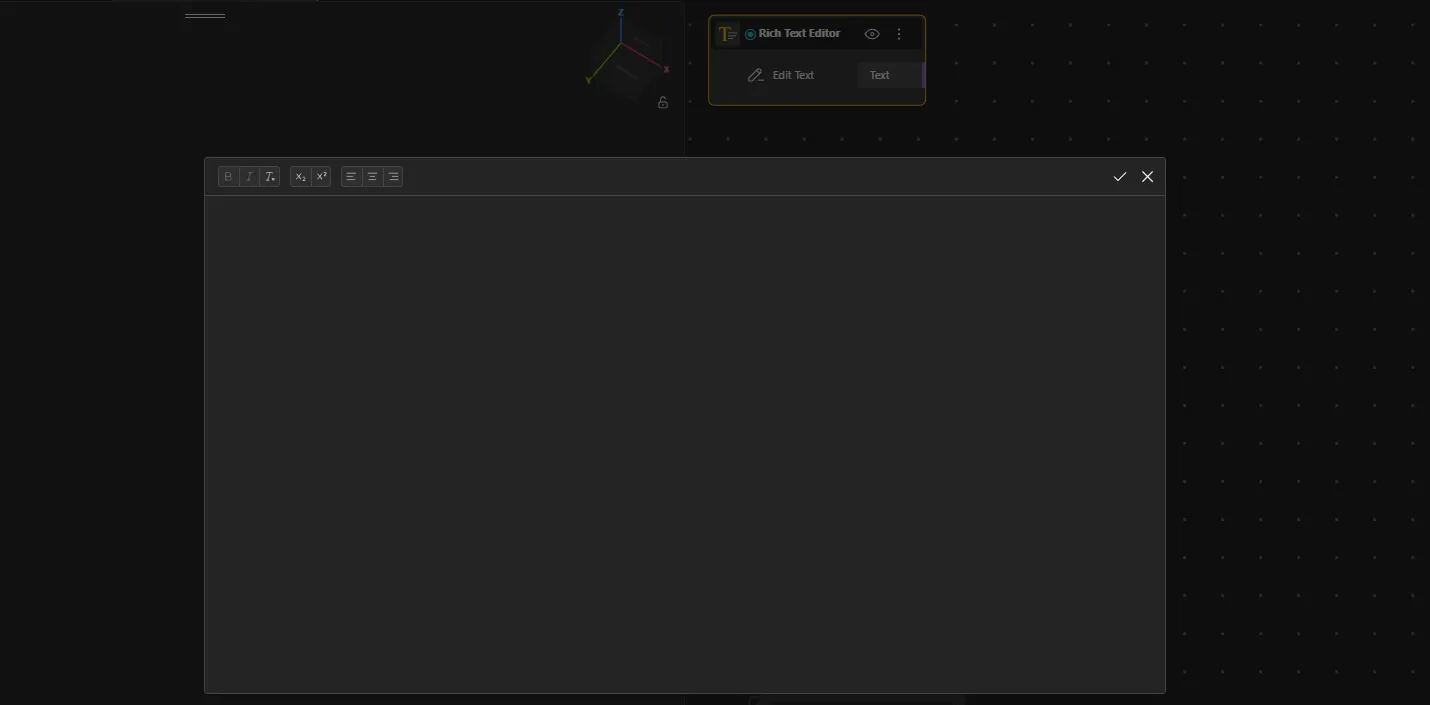
Enables text input with formatting capabilities - bold, italic, font size, and other rich text modifications. Output includes formatting metadata. Default: empty formatted text. Provides a WYSIWYG-style editor. Output is formatted text, not plain string - compatible with nodes that accept rich text rendering.
Inputs
None
Outputs
Formatted Text
Pairs With
Text
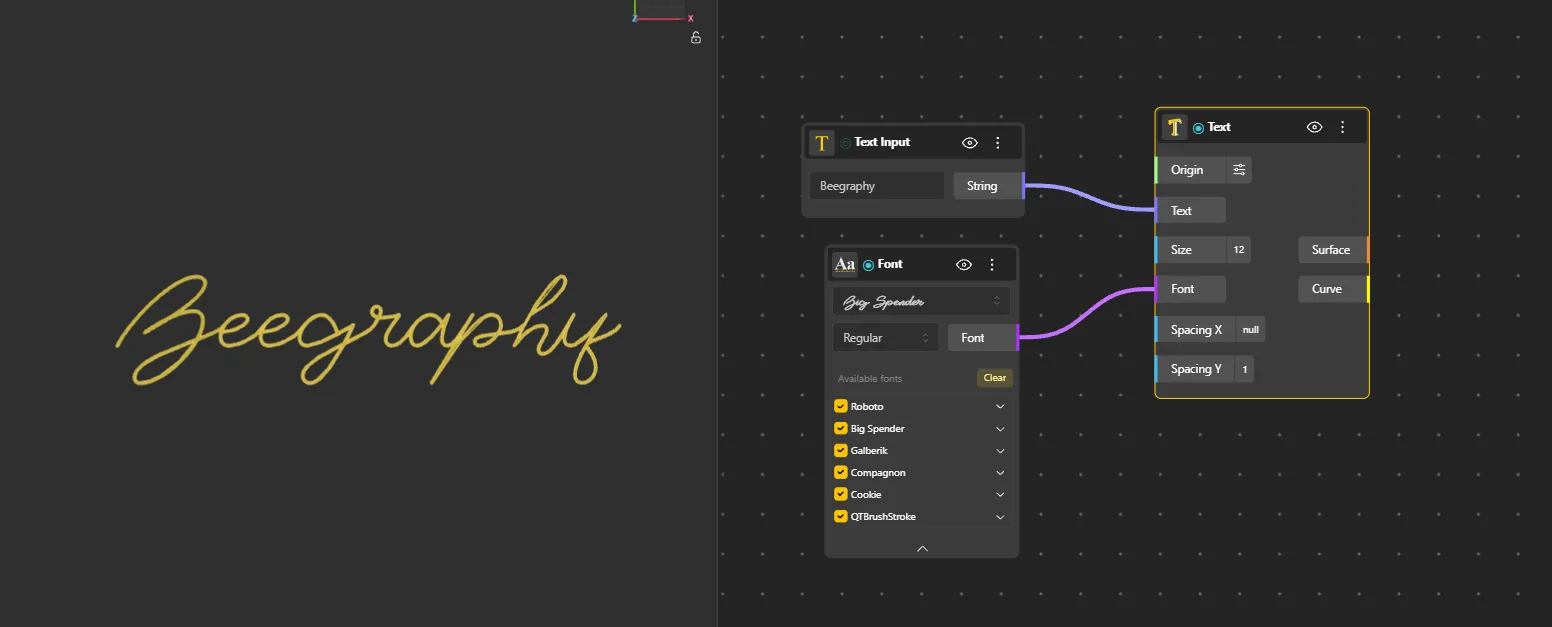
Font
Behavior
Selects a font for text manipulation. Fonts must be pre-uploaded via the Assets section of the workspace before they appear in this node's dropdown. Default: system default font. Only fonts uploaded to the project's Assets are available. The output is a font reference consumed by Text nodes to render 3D text geometry.
Inputs
None
Outputs
Font
Pairs With
Text, Text Distance
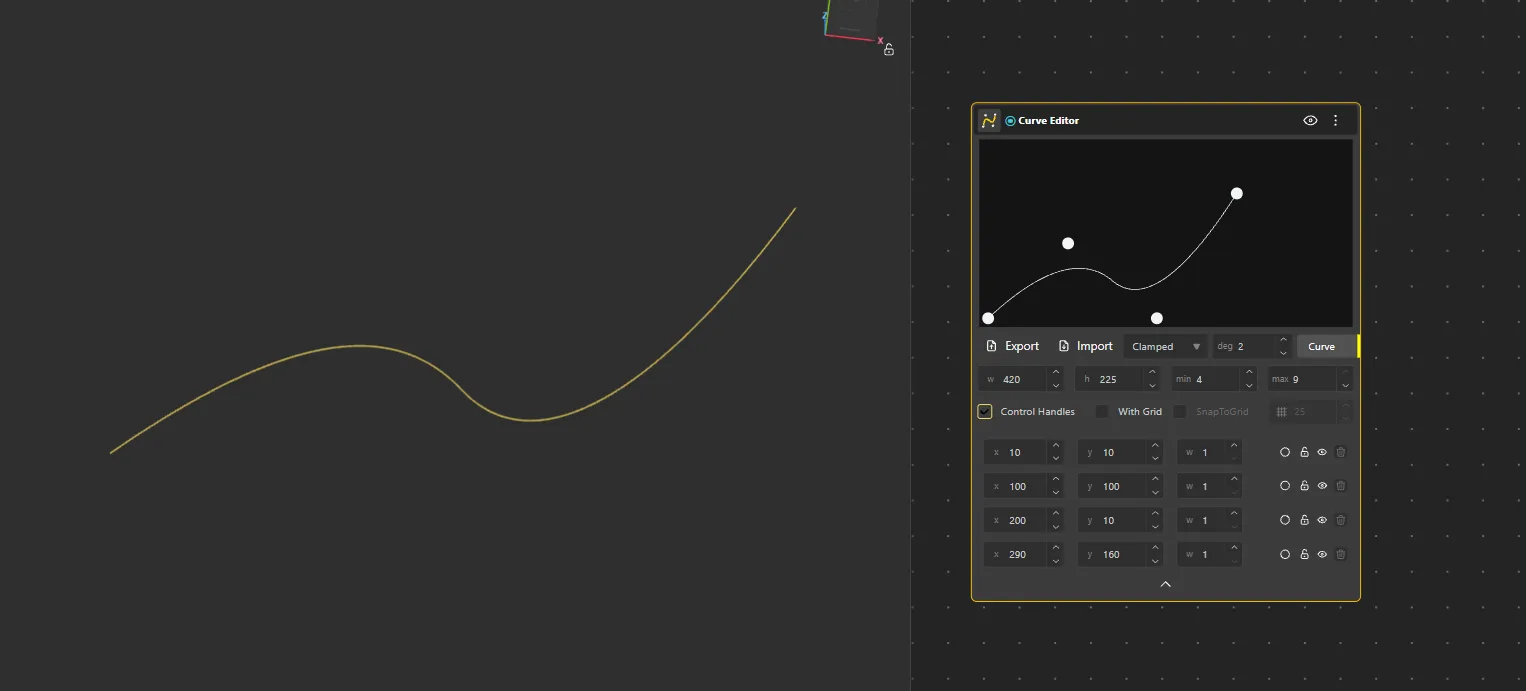
Curve Editor
Behavior
Provides an interactive curve graph for defining custom value distributions. Allows users to draw a response curve that maps input parameters to output values. Default: linear curve (straight diagonal). The curve editor provides control points that can be dragged to shape the response. Used for easing functions, custom falloff patterns, and non-linear parameter mapping.
Inputs
Parameter
Outputs
Value
Pairs With
List Sequence, Range Input
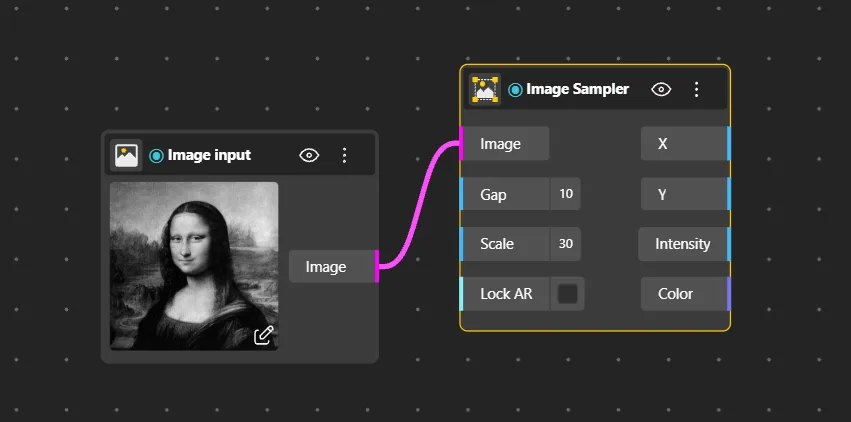
Image Input
Behavior
Accepts an image file as input. The image can be used as a texture, reference, or input for image-processing nodes. Appears as an image upload control in Configurator mode. Default: no image loaded. Supports common image formats (PNG, JPG, SVG). Image must be uploaded to the project Assets or provided by the end user in Configurator mode.
Inputs
None
Outputs
Image
Pairs With
Apply Material, Parse Vector Graphics
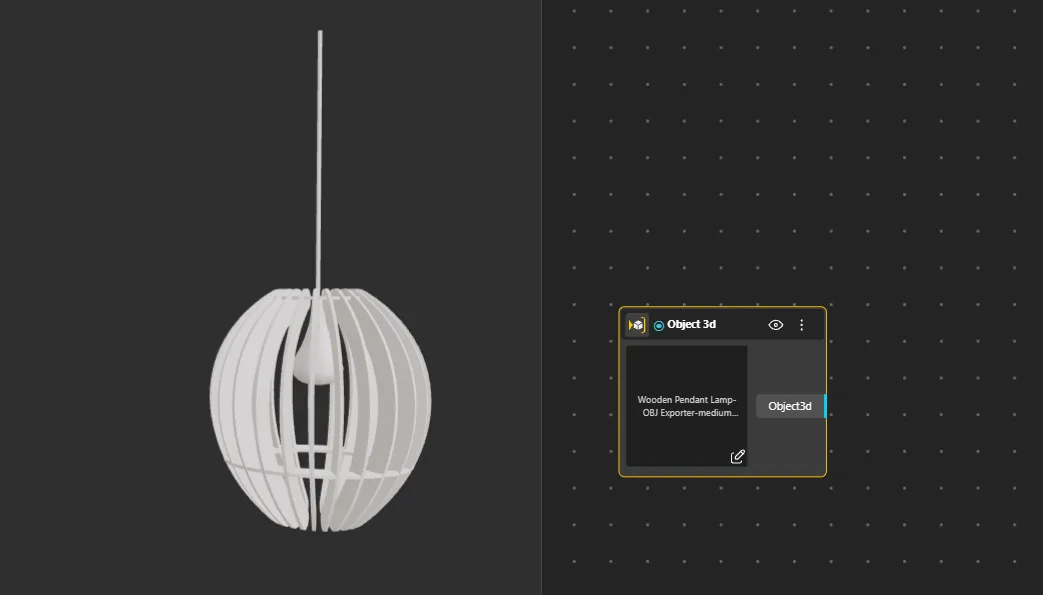
Object 3D
Behavior
Imports a 3D object file as input geometry. Allows external 3D models to be brought into the node graph for combination with parametric geometry. Default: no object loaded. Accepts uploaded 3D files from the project Assets. The imported geometry can be transformed, arrayed, and combined with other nodes in the graph.
Inputs
None
Outputs
Geometry
Pairs With
Move, Scale, Rotate
Vector Graphics Input
Behavior
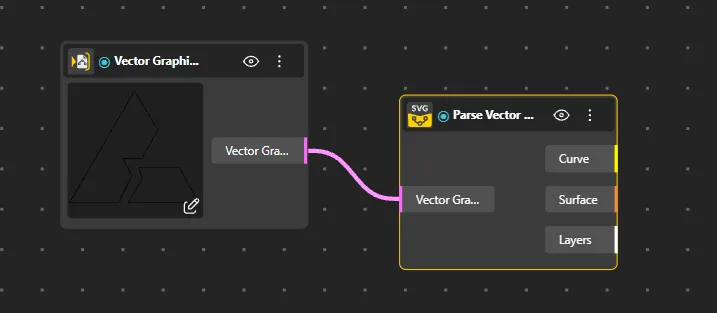
Accepts vector graphics (SVG) as input. The imported vector data can be parsed into curves and used as geometry within the node graph. Default: no file loaded. Works with SVG files uploaded to project Assets. Use Parse Vector Graphics to extract individual curve layers from the input.
Inputs
None
Outputs
Vector Graphics
Pairs With
Parse Vector Graphics, Filter By Layer Operation
Apply Material
Behavior
Provides a material definition for applying visual properties to geometry. Allows setting color, metallicity, roughness, opacity, and texture in a single node. Default: default material with no texture. Outputs a material reference that can be applied to geometry via Apply Material. In Configurator mode, end users can select from predefined material options.
Inputs
None
Outputs
Material
Pairs With
Apply Material
UV Mapping
Behavior
Provides UV coordinate mapping for controlling how textures are projected onto geometry. Defines the texture coordinate space for material application. Default: planar UV projection. UV mapping controls how 2D textures wrap around 3D surfaces. Adjusting UV parameters changes texture scale, rotation, and offset on the geometry.
Inputs
None
Outputs
UV Data
Pairs With
Apply Material, Texture
Texture
Behavior
Provides a texture image for use in material application. Textures are loaded from project Assets and mapped onto geometry via UV coordinates. Default: no texture loaded. Texture output feeds into Apply Material's texture port. Combined with UV Mapping for precise control over texture placement on surfaces.
Inputs
None
Outputs
Texture
Pairs With
Apply Material, UV Mapping
Graph Mapper
Behavior
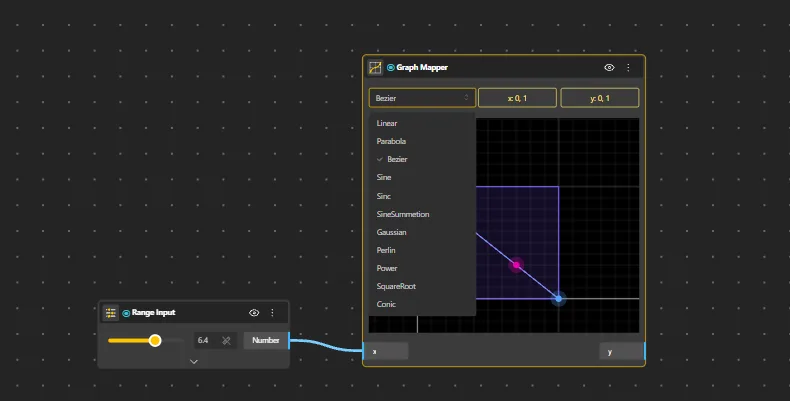
Remaps and reshapes values through customizable graph curves to create smooth transitions and dynamic parametric behavior. Provides visual control over value distribution using predefined mathematical curves. Default: linear mapping (straight diagonal). Select a graph type (sine, cosine, bezier, parabola, gaussian, etc.) and drag control points to shape the response curve. Input values (typically 0-1) are mapped through the curve to produce shaped output values. Example: a sine graph maps a linear input into a smooth wave pattern - use this to create undulating heights across an array of geometry.
Inputs
Values
Outputs
Mapped Values
Pairs With
List Sequence, Range Input, Curve Editor
Math Expression
Behavior
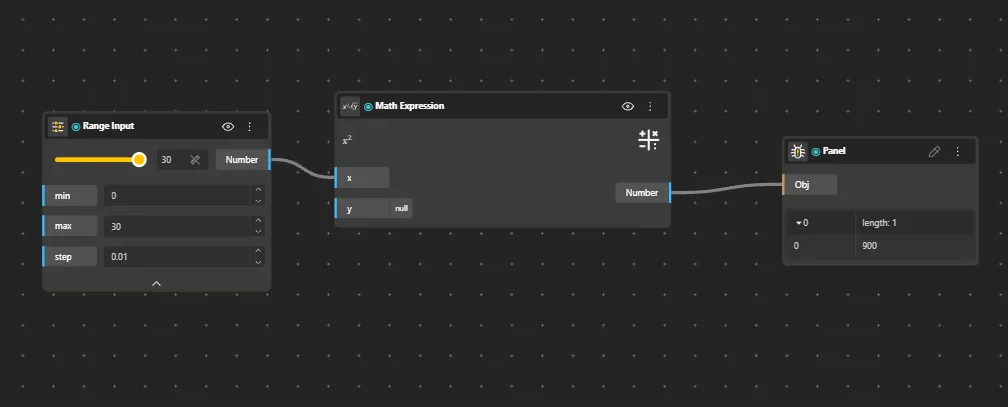
Evaluates a custom mathematical formula and returns a computed number. Write any expression directly instead of wiring multiple math nodes together - a single node replaces chains of Addition, Multiplication, Sine, etc. Default: empty expression. Supports standard operators (+, -, *, /, ^), trigonometric functions (sin, cos, tan), constants (PI, E), and custom variables. Variables are automatically created as input ports when referenced in the formula. Example: typing "sin(x) * r + h" creates three input ports (x, r, h) and computes the expression for each combination of inputs.
Inputs
Variables
Outputs
Result
Pairs With
Range Input, Number Const, Construct Point