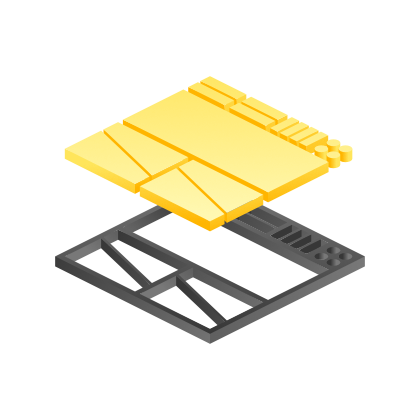
Nesting
Nesting MaxRects Best Fit
NestingMaxRectsBestFit is a rectangle nesting algorithm used to place multiple rectangular shapes into a larger container while minimizing wasted space. It works by tracking the largest available free rectangles in the container and placing each new item in the position where it best fits according to a chosen heuristic (usually minimal leftover space).
Docs for v2.1.21, the latest version.
ID
nesting-rectangular-nesting-nesting-maxrects-best-fitGroup
Rectangular Nesting
Plugin
NestingKeywords
Nesting MaxRects Best Fit
Rectangular Nesting
Ports
Inputs
7
What the node takes in, from wires or typed values.
Origin
Default [0,0,0]
Origin
Geometries
List of geometries to be nested
Sheet Width
Default 500
Width of the sheet used for nesting
Sheet Height
Default 500
Height of the sheet used for nesting
SheetsGap
Default 10
Spacing between sheets
Edge Clearance
Default 0
Distance from the edges of the sheet to the curves/surfaces to be nested
Spacing
Default 0
Distance between curves
Outputs
6
What the node gives out, to wire into other nodes.
Sheets
Sheet boundary curves. Flat array of rectangular curves representing each sheet used in the nesting.
Geometries
Nested geometries in their final positions. Flat array of all geometries in the order they appear across all sheets.
Move Vectors
Translation vectors for each input geometry. Array aligned with input geometries showing movement from original position. Unplaced geometries have zero vectors.
Rotation Angles
Rotation angles in radians for each input geometry. Array aligned with input geometries showing rotation applied. Unplaced geometries have zero rotation.
Sheet IDs
Sheet index for each input geometry. Array aligned with input geometries showing which sheet each geometry is placed on. Unplaced geometries have value -1.
Geo IDs
Original input geometry indices. Flat array showing which input geometry corresponds to each nested geometry.
This node has no documentation beyond its description and ports yet.